Bike tour
Lech Cycle Path - From the Alps to Augsburg
Cycle the Lech River from the Alps to Augsburg – Enjoy alpine views, historic towns, and riverside paths on this relaxed route through Austria and Bavaria.

Rob
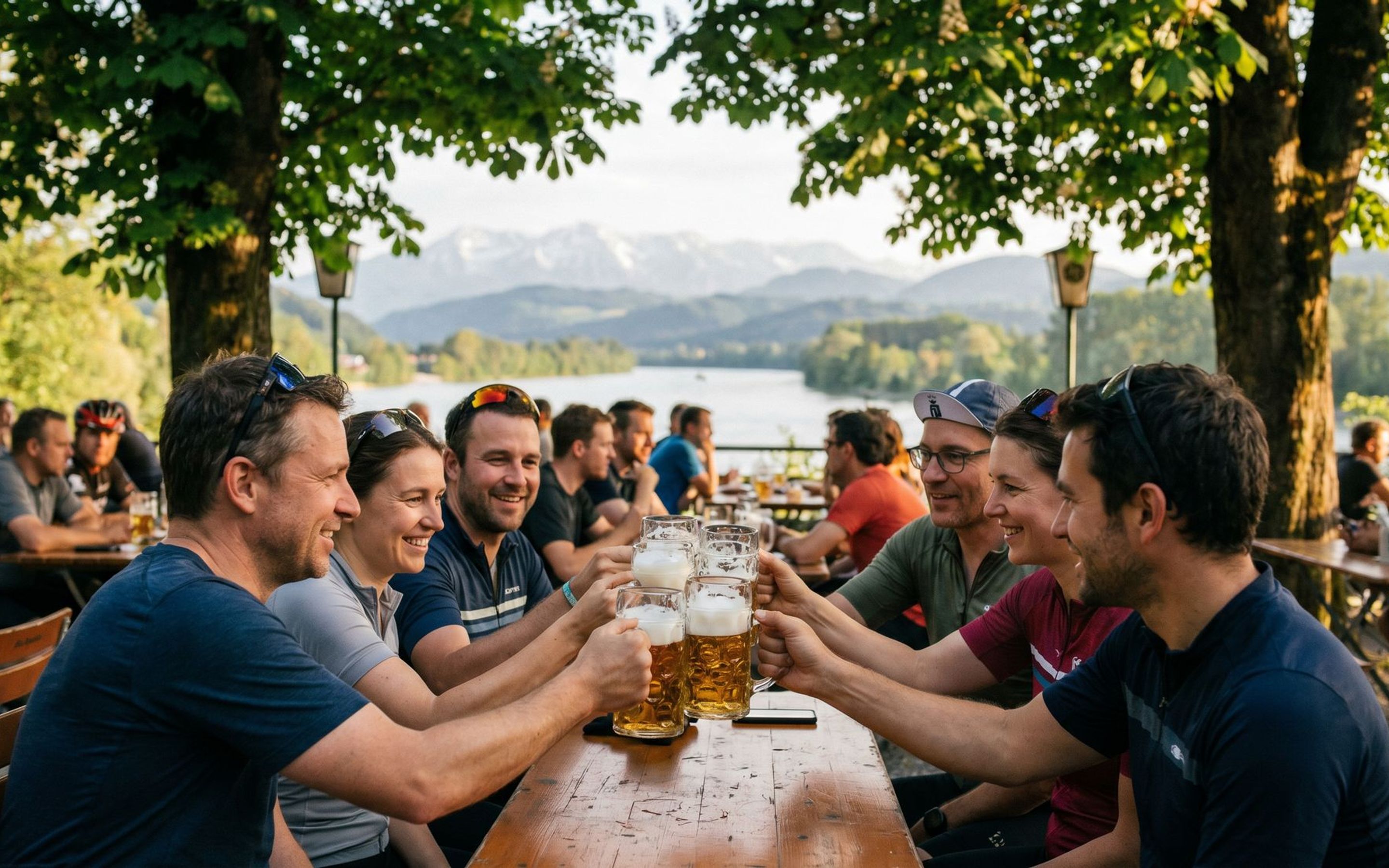
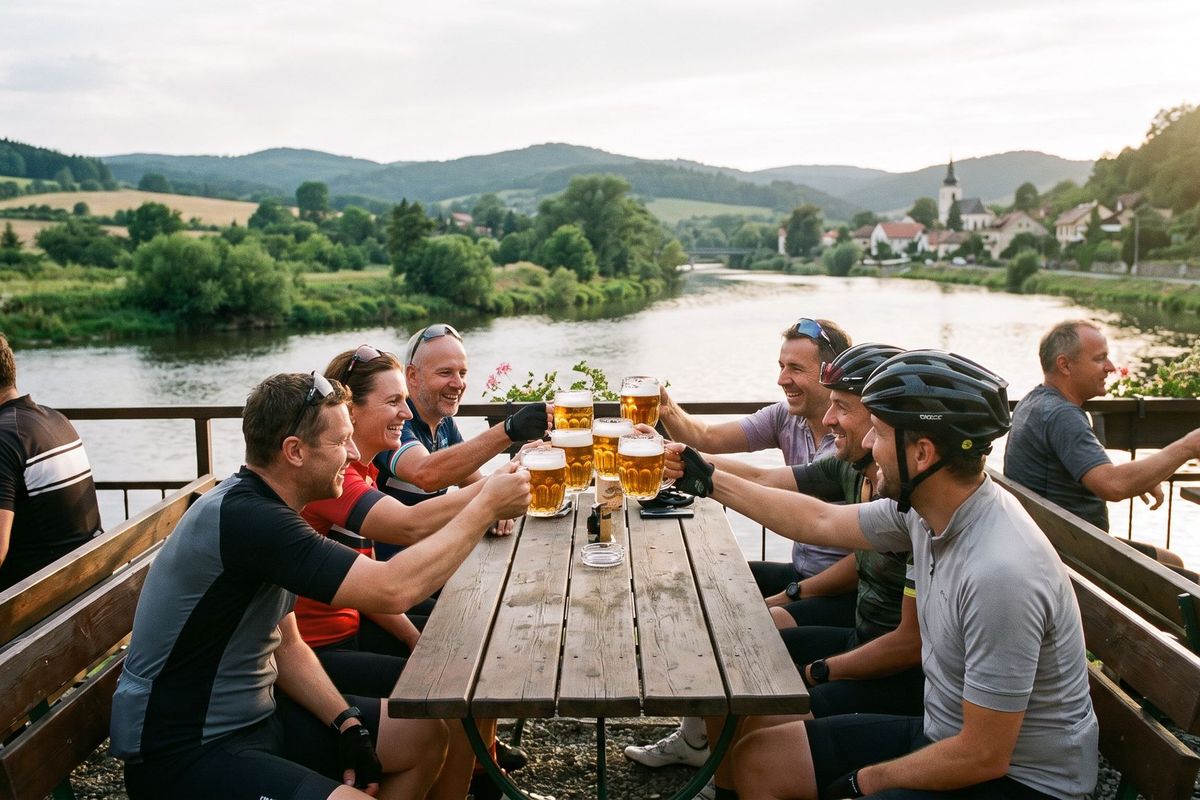
It is a little after four in the afternoon, the Danube is sliding past on your left, and you roll off a flat gravel path into the courtyard of a beer garden under chestnut trees. Your bags are already at the guesthouse a few streets away. Your legs feel worked but not wrecked. Someone brings a half-litre and a pretzel the size of a dinner plate, and the only decision left in the day is whether to have a second before dinner.
That is the shape of most days on a cycling holiday in Bavaria, and it is why the region suits people who like the idea of a cycling holiday more than they like the idea of suffering for one. If you are weighing up bavaria cycling holidays, here is the short version: the riding is genuinely easy — long stretches of flat, well-surfaced riverside path — but the days are full. You pedal from Munich beer gardens to riverside abbeys to fairytale castles in the Alpine foothills. It is a big-reward holiday you do not have to earn in your legs, which makes it one of the best places in Europe to take a first cycling trip, or a mixed-ability group, without anyone feeling out of their depth.
Bavaria works because its best cycling follows rivers, and rivers do not climb. The two headline routes — the Danube Cycle Path and the Altmühltal Cycle Path — run along valley floors on dedicated, largely traffic-free trails that Germany's cycling club, the ADFC, rates four stars for surface and signposting. You are rarely sharing tarmac with cars, and you are almost never grinding up a hill you did not choose.
What lifts it above a simple flat pedal is what sits alongside the path. In a single week you can ride through Regensburg, one of the best-preserved medieval cities in Germany, drink at monastery breweries that have been at it for the better part of a thousand years, and finish within sight of Neuschwanstein, the castle that inspired Disney's. The cycling gives the days their rhythm. The beer gardens, abbeys and castles give them their reason.
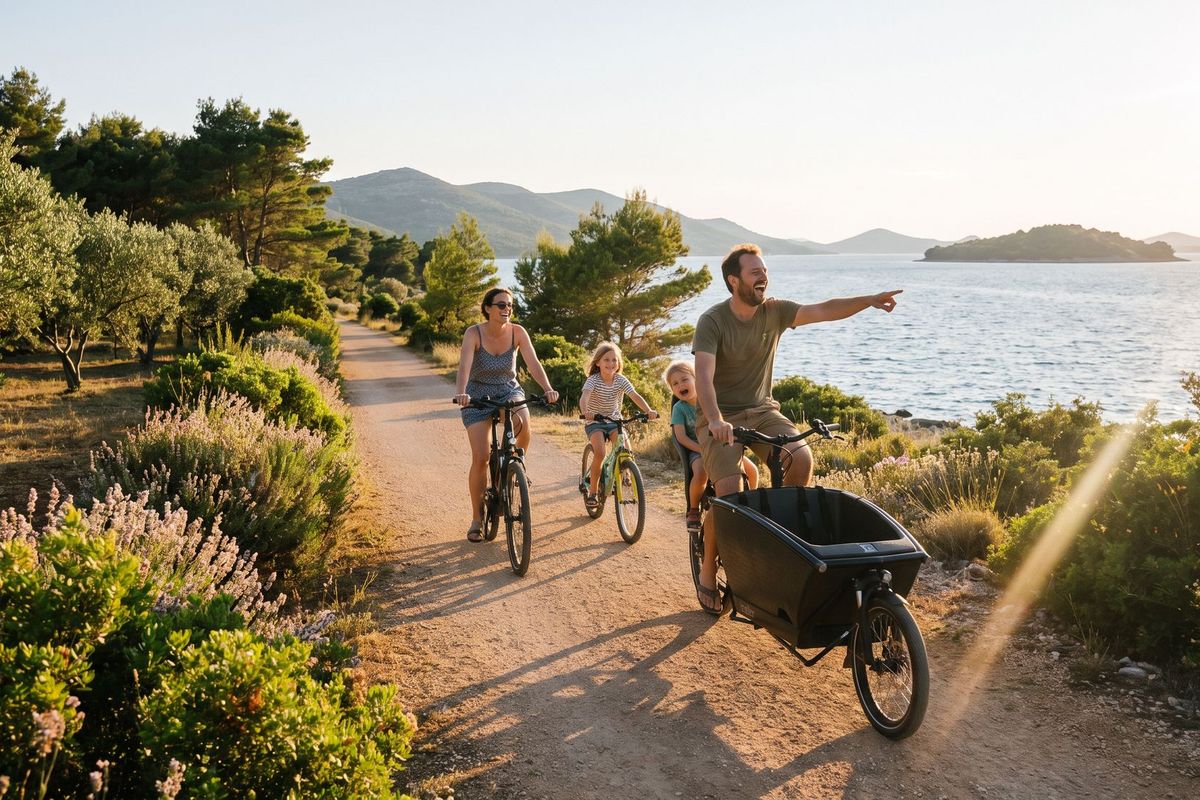
It also travels well as a group. Because the flat sections ask so little, a couple in their sixties, a foursome of friends and a family with teenagers can all ride the same route and enjoy it, with e-bikes smoothing over any gap in fitness. Bavaria is part of Pedal Ventures' wider cycling holidays in Germany collection, and it is the region we most often point first-timers towards for exactly this reason.
Cycle the Lech River from the Alps to Augsburg – Enjoy alpine views, historic towns, and riverside paths on this relaxed route through Austria and Bavaria.
Most Bavaria cycling holidays are built around one of three river or lake routes. Each is flat, well-served with bike-friendly guesthouses, and easy to break into comfortable day stages.
Very. The Danube Cycle Path — the Donauradweg — accompanies the river for roughly 420 kilometres across Bavaria, and because you ride downstream the gradient works quietly in your favour the whole way. The classic Bavarian stretch runs from Regensburg to Passau, about 150 kilometres, and splits neatly into three unhurried days: Regensburg to Straubing (around 55km), Straubing to Deggendorf (around 40km), and Deggendorf to Passau (around 60km). None of it is hard. The landscape shifts from open Bavarian farmland into steeper, wooded gorge country as you approach Passau, the "City of Three Rivers", where the Danube, the Inn and the Ilz meet.
Passau is also the point where Bavaria hands you over to Austria. It is the traditional start of the Passau-to-Vienna run, the most popular multi-day river ride in Europe, so it is common to combine a few Bavarian days with a push downstream. If you want the full picture of the route beyond Bavaria, our complete guide to the Danube Cycle Path covers it end to end. For the Bavarian and cross-border stages specifically, browse the Danube region tours.
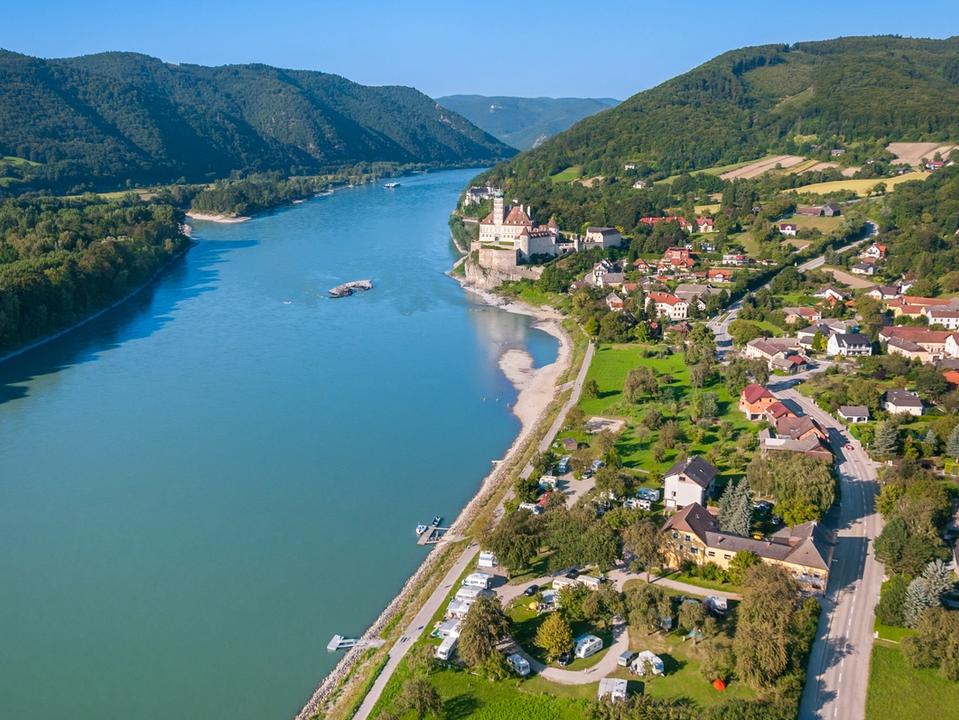
Explore the Danube by bike and boat from Passau to Budapest, visiting Vienna, Bratislava and scenic villages along the way.
The Altmühltal Cycle Path is Bavaria's quieter alternative, and for many riders the more charming one. It follows the Altmühl river through a nature park of limestone cliffs, juniper meadows and small medieval towns, running roughly 245 kilometres from Rothenburg-country down to Kelheim, where the Altmühl joins the Danube. The gradient over the whole route drops less than 120 metres, so it rolls so gently downhill you barely register it — genuinely flat cycling with a fraction of the traffic of the main Danube corridor.
Kelheim is worth planning around. Just downstream sits Weltenburg Abbey, one of the oldest monastery breweries in the world, reached through the dramatic Danube Gorge where the river narrows between white cliffs. Arriving there by bike and boat, dark beer in hand, is the kind of afternoon that sells the whole trip.
You can, and it is one of the most family-friendly rides in the region. The Lake Constance Cycle Path — the Bodensee-Radweg — loops around the lake for about 260 kilometres across three countries, Germany, Austria and Switzerland, on flat, exceptionally well-marked paths. Bavaria's shoulder of the lake centres on Lindau, an island town of painted houses and a harbour framed by a stone lion and a lighthouse. From there you can ride south into the Austrian and Swiss shores or north-west along the German side.
Because the loop is fully signposted and never far from a train station, it is easy to ride only the sections you fancy rather than committing to the whole circuit. Pedal Ventures lists supported trips here through the Lake Constance region, including the Palaces and Panoramic Views route, for riders who want lake days without long distances.
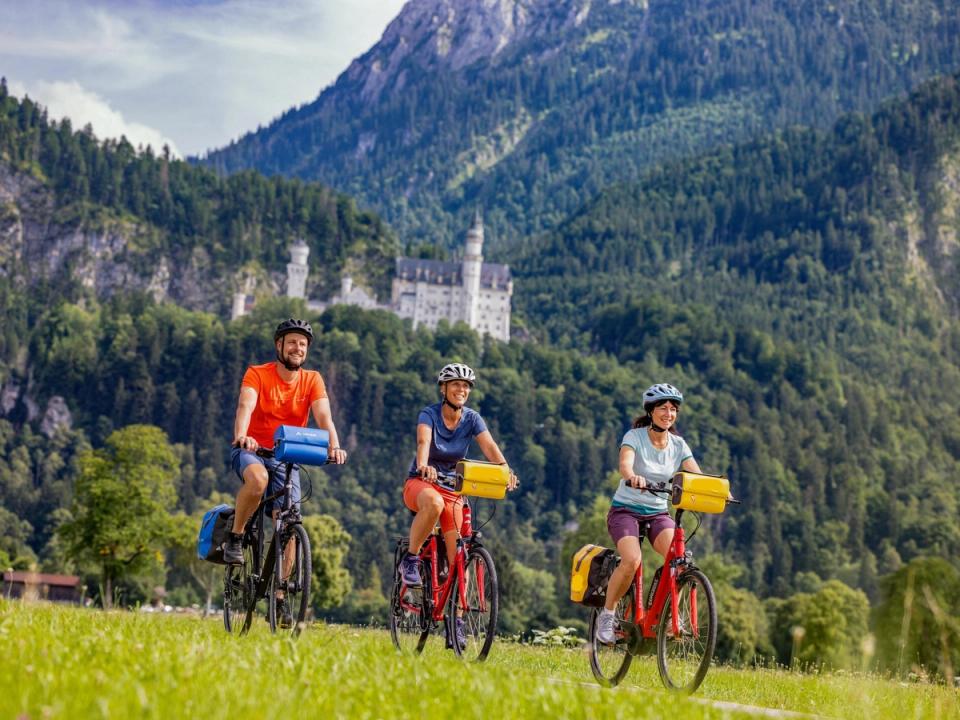
Discover Bavaria by bike from Lake Constance to Königssee. Ride past lakes, castles, and charming Alpine villages.
Because in Bavaria the evening is half the holiday, and the culture is unusually easy to reach from the saddle. This is a place built for the after-ride.
Start in Munich. The English Garden, one of the largest urban parks in the world, has around 78 kilometres of paths, and at its heart stands the Chinese Tower — a five-storey wooden pagoda first raised in 1789 — ringed by one of the city's classic beer gardens. You can cycle out along the Isar to the Aumeister, another beer garden under the trees, and loop back through the park to the old town without touching a busy road. Our Munich Lakes tour, cycling the Isar and discovering Bavaria, uses exactly this kind of gentle, water-following riding to string the city and the countryside together.
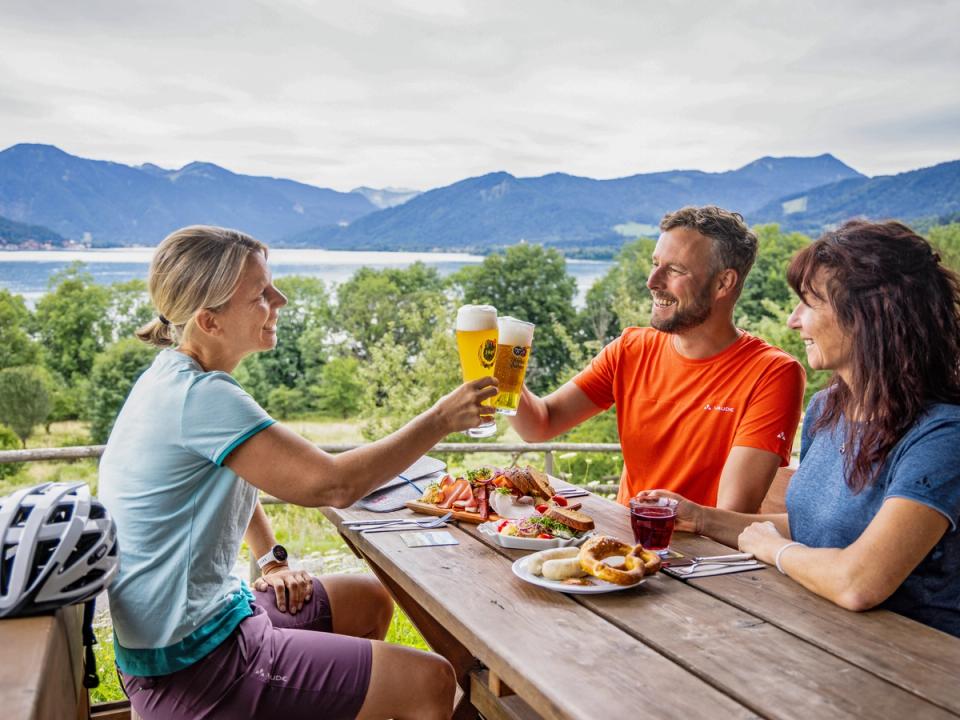
Cycle from Munich through Bavaria’s stunning lakes and charming towns on this scenic 6-day self-guided tour.
Beyond Munich, the beer itself becomes a route in its own right. Franconia, in Bavaria's north, has one of the highest densities of breweries anywhere, and towns like Bamberg — a UNESCO-listed old city known for its smoked Rauchbier — reward a slow day in the saddle with a very good one at the table. We have mapped several of these in our guide to the best brewery bike routes in Germany, and it pairs naturally with any Bavarian river trip.
For the Active Couple and the Foodie Cyclist especially, this is the argument for Bavaria over a harder-riding destination. You are not choosing between a proper ride and a proper dinner. The flat terrain means you can have both, most days, without a reserve tank of fitness.
Yes, and it is gentler than the mountain backdrop suggests. The Allgäu, in Bavaria's south-west around the town of Füssen, is where the flat farmland finally rises into the Alps — but the cycle paths stay in the foothills and around the lakes, so you get the drama of the peaks without the climbs to match.
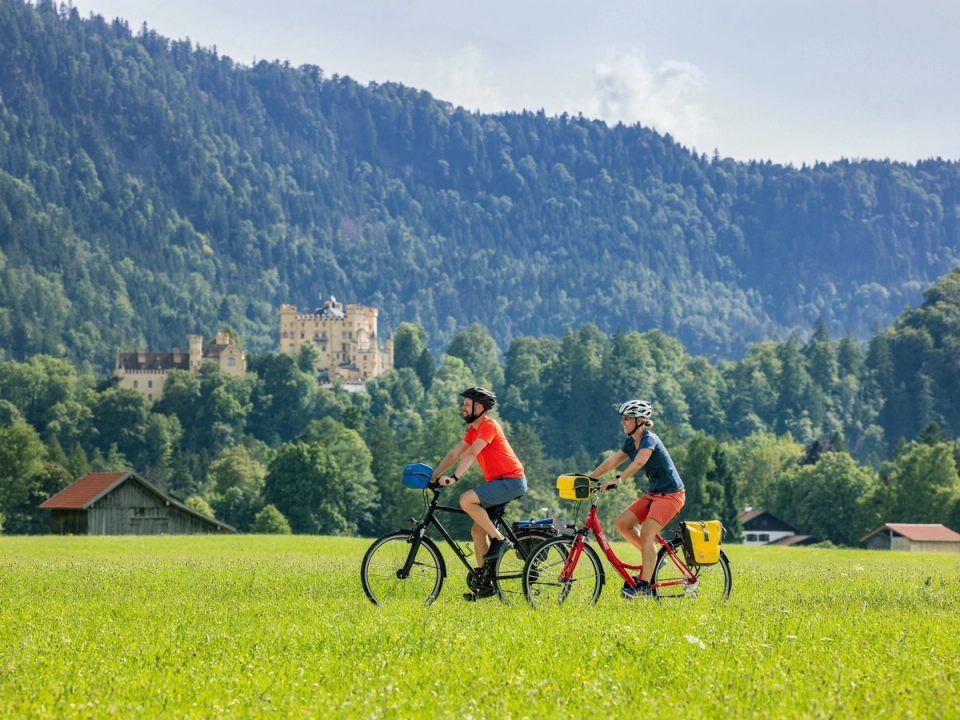
The signature ride here loops the Forggensee, a turquoise reservoir just north of Füssen, on a well-surfaced path of about 32 kilometres with the Alps filling the horizon. From several points on the loop you catch the postcard view of Neuschwanstein Castle perched on its wooded crag above Hohenschwangau. It is an easy half-day, and it is the sort of scenery that makes people who came for the food stay for the cycling.
The foothills are also where you feel the value of an e-bike most. The valley floors are flat, but the odd approach to a viewpoint or a lakeside village pitches up, and a little electric assistance turns those from a grind into a non-event. It keeps a mixed-ability group together, which matters more here than on the pancake-flat rivers.
The Bavarian cycling season runs roughly May to October, and the sweet spots sit at either end of the summer.
May, June and September are the pick for most riders: daytime temperatures typically in the low-to-mid twenties Celsius, long daylight, and the river paths busy but not crowded. July and August are warmer and livelier — good if you want beer-garden evenings at their fullest, though the honeypots around Neuschwanstein and Lindau get busy. September has a particular charm along the rivers, with harvest festivals in the wine and beer country and the crowds thinning noticeably.
Spring can be showery and the Alpine-foothill lakes stay cool into early summer, so pack a light waterproof whatever the month. If you are trying to line up the best conditions across the continent more broadly, our best time to cycle in Europe guide puts Bavaria in context alongside other destinations. For up-to-date practical and safety information before you travel, check the FCDO's travel advice for Germany.
Easier than almost any other cycling holiday in Europe, if you stick to the rivers — and we would rather tell you that plainly than hedge it.
The Danube, Altmühl and Lake Constance routes are flat to gently rolling, on sealed or well-graded surfaces, with daily distances that most trips set at 40 to 60 kilometres. If you can ride a bike for a couple of hours on the flat with lunch in the middle, you can do these routes. They are a sound choice for a genuine first cycling holiday, for families with older children, and for groups who do not all ride at the same pace. The German tourism board's own Danube Cycle Path overview and Bavaria's long-distance route listings back up how consistently these paths are graded for leisure riders.
The Alpine foothills add mild effort rather than real difficulty, and an e-bike erases even that. Where difficulty does creep in is only if you deliberately seek it — linking Bavaria into a longer Alpine crossing, or stacking back-to-back 80-kilometre days. On Pedal Ventures every listed trip carries a difficulty rating, so you can match the route to the least-fit person in your group rather than the most-fit, which is usually the honest way to choose.
Most Bavaria cycling holidays are self-guided, and the logistics are handled for you so the riding stays the easy part. Your luggage moves ahead by van from one guesthouse to the next while you ride with a day-bag. Accommodation is booked and sequenced along the route. You get GPS files and route notes, and you set your own pace with no group to keep up with. It is independence without the planning headache, which suits the Active Couple and the Friends Group who want flexibility over a fixed schedule. The riverside routes are so well-signed that many riders barely glance at the notes.
Pedal Ventures is a marketplace, not a tour operator. We do not run the trips ourselves — we connect you with handpicked local operators in Bavaria whose routes and accommodation we have vetted, so that if we would not book it ourselves, it is not on the site. That local knowledge is the difference between a route that hugs the scenic riverbank and one that skirts a bypass.
On a holiday that averages around £3,000 for two, booking confidence matters, and this is where financial protection earns its place. Bookings made through Pedal Ventures are PTS-protected, which means your money is safeguarded if either the operator or Pedal Ventures were to fail before you travel. You are booking online, in your own time, with that protection built in — no phone queue, no posted itinerary, no wondering where your deposit has gone.
No. The main routes — the Danube, the Altmühltal and Lake Constance — are flat to gently rolling, with typical days of 40 to 60 kilometres on well-surfaced paths. If you can comfortably ride a bike for a couple of hours on the level, you can manage them. E-bikes are widely available and make mixed-ability groups effortless.
The Regensburg-to-Passau stretch of the Danube Cycle Path is the classic beginner choice: about 150 kilometres over three gentle downstream days, almost entirely on traffic-free trails. The Altmühltal Cycle Path is an equally easy and quieter alternative through a limestone nature park.
Yes, and many riders do. Passau, on the Bavarian-Austrian border, is the traditional start of the Passau-to-Vienna route, the most popular river ride in Europe. It is straightforward to spend a few days on the Bavarian Danube and continue downstream into Austria.
It is one of the better European regions for it. The flat, signposted river and lake paths suit older children and teenagers, the distances are manageable, and the mix of castles, beer-garden lunches and lake swims keeps non-cyclists interested. E-bikes for the adults help on the Alpine-foothill days around Füssen.
May, June and September offer the best balance of warm-but-not-hot weather and manageable crowds. July and August are warmer and busier, best if you want the beer gardens at their liveliest. Bring a light waterproof in any month, as showers are common.
Yes. Bookings made through Pedal Ventures are PTS-protected, so your money is safeguarded if the local operator or Pedal Ventures fails before you travel. Pedal Ventures is a marketplace that connects you with vetted local operators, and you book online with that protection included.
Bavaria is the cycling holiday you can talk your least-sporty friend into and still come home having earned every dinner. Flat rivers, real culture, and an Alpine finish, all without the fitness barrier that puts people off. When you are ready to see the routes in detail, explore the handpicked Bavaria cycling holidays on Pedal Ventures and find the one that fits your pace, your group and your appetite.