Bike tour
The Ionian Islands and the Gulf of Corinth
Discover Greece on this bike & boat tour from Athens to Corfu, passing through the Gulf of Corinth and scenic Ionian Islands.
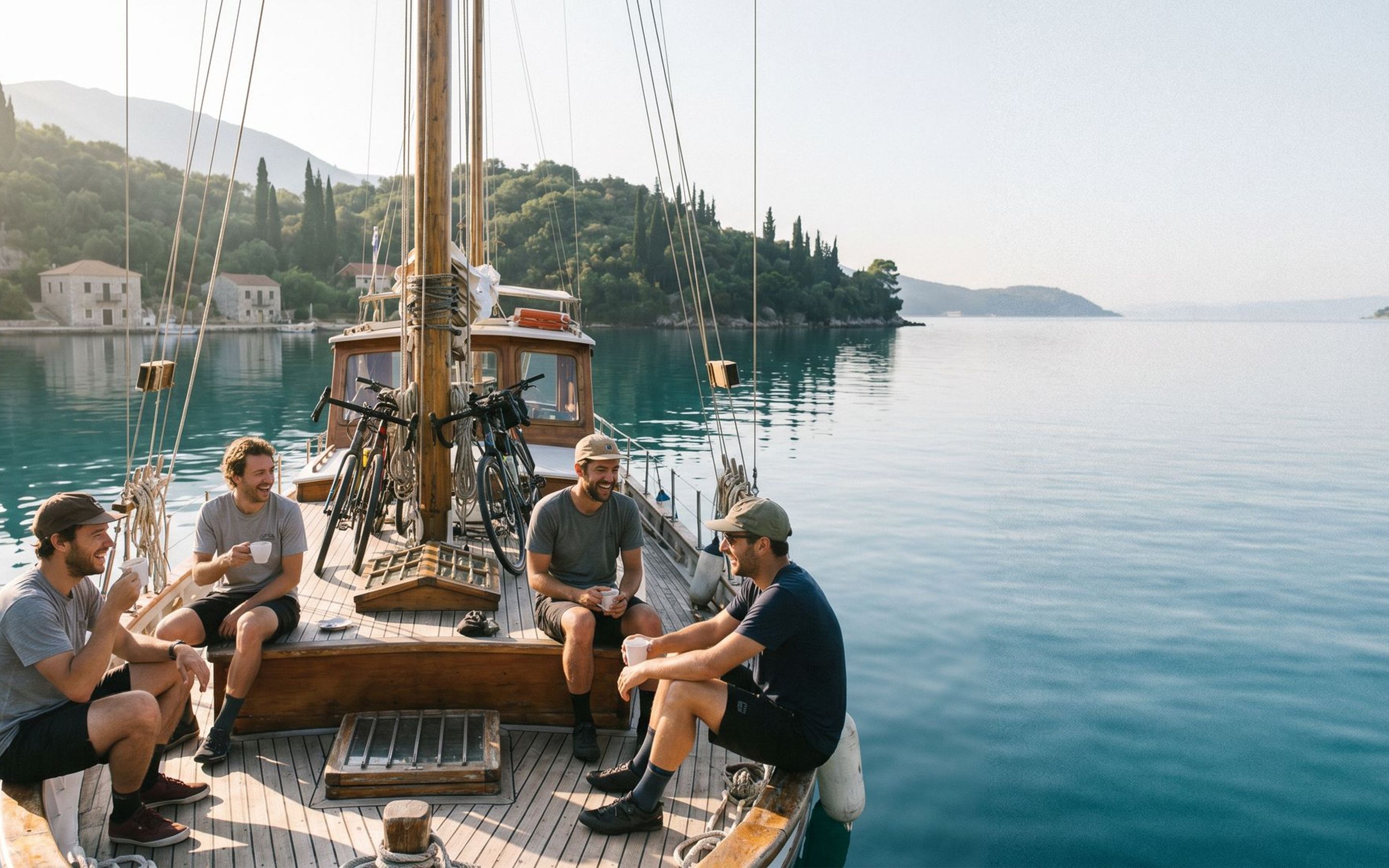
You finish the morning's ride in a small harbour on the west coast of Lefkas, hot from the last climb, and the boat is already there waiting. Ten minutes later you are in the water off the stern, the bikes racked on deck, lunch being laid out under an awning. By the time you have dried off, the crew has cast off for the next island. This is the rhythm that most cycling tours Greece is known for once you cycle by bike and boat, and it is the reason the format has quietly become the sensible way to ride these islands rather than a novelty.
This guide walks you through how it actually works: which regions suit which kind of cyclist, how hard the riding really is, when to go, and what a day on board feels like. If you already know you want to ride here, you can jump straight to our cycling tours Greece collection; if you are still weighing it up against Italy or France, read on. Greece is a genuinely different proposition, and the bike-and-boat format is what makes it work.
Most European cycling holidays follow a straightforward pattern: you ride from town to town, your luggage is moved ahead, and you sleep in a different hotel each night. That model works beautifully across the Loire, the Danube or Puglia. It does not translate to a country made of more than 200 inhabited islands.
The problem is joins. Ferries between the larger Greek islands run reliably, but connections between the smaller ones can be infrequent, seasonal, or timed for locals rather than travellers. Plan a self-guided island route on paper and you quickly find yourself building the whole holiday around a Tuesday sailing that leaves at 6.50am. Accommodation quality on the quieter islands also varies far more than it does on the mainland, which makes a pre-booked land itinerary a gamble.
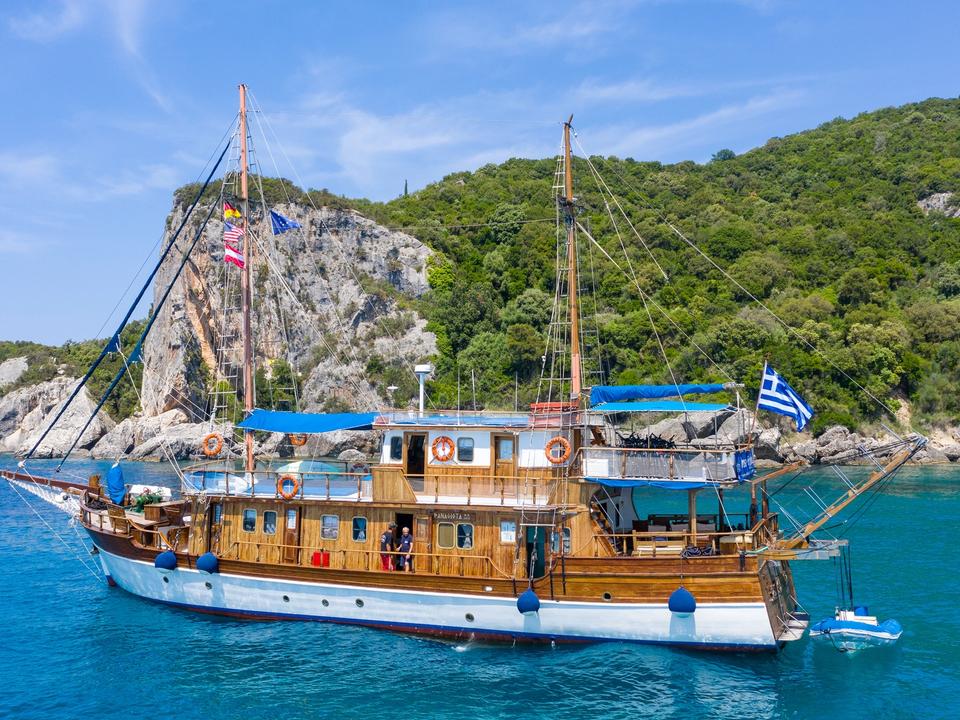
A boat solves all of that at once. It is your hotel, your luggage transfer and your ferry in a single vessel. You unpack once. You wake up already at the next island, ride a loop or a point-to-point stretch, and come back to the same bed. The boat can drop you at a beach for the road that has no bus, and pick you up from a harbour with no hotel. On the Ionian bike and boat tours this typically means a traditional two-masted motor sailer such as the Panagiota, carrying a small group between Corfu, Lefkas, Cephalonia and Paxos.
Discover Greece on this bike & boat tour from Athens to Corfu, passing through the Gulf of Corinth and scenic Ionian Islands.
Compared with trying to string the same route together by public ferry and hotels, the difference is not marginal. It is the difference between a holiday that flows and one that becomes a logistics exercise. That is the honest case for the format, and it is why nearly every serious operator running Greek island cycling uses a boat rather than a land base.
Greece is not one cycling destination but several, and they ride very differently. Here is how the main regions compare, from gentlest to most demanding.
The Ionians sit off the west coast: Corfu, Lefkas, Cephalonia, Ithaca and Paxos, with smaller Meganisi and Antipaxos in between. They are the green side of Greece, kept lush by winter rain, with cypress, olive groves and Venetian architecture in the old towns. The riding is moderately hilly rather than brutal, with plenty of coastal stretches and short inland climbs to villages.
This is where most people should begin. Distances are manageable, the scenery is soft and varied, and the islands are close enough together that boat crossings are short. Fiskardo's harbour on Cephalonia, the Melissani Cave, and the white cliffs of Lefkas are the kind of concrete highlights you can build a day around. If it is your first Greek island cycling holiday, start here.
Strictly the Peloponnese is mainland, a large peninsula south-west of Athens, ringed by the Saronic Gulf islands of Hydra, Aegina, Spetses and Poros. The appeal is density of history: you can ride past ruins older than Rome, through olive groves, and into car-free harbour towns, all within easy reach of Athens airport.
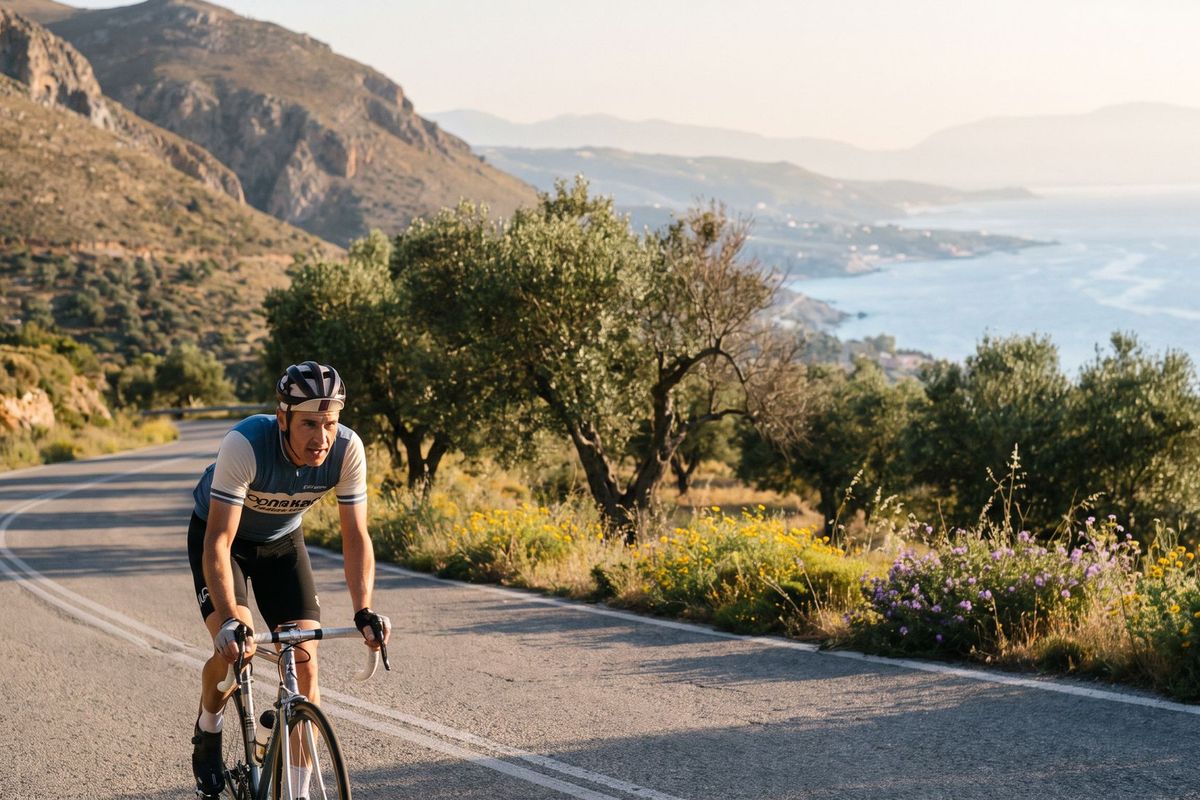
The terrain here rewards an e-bike. There are proper climbs inland, and the coastal roads roll more than they flatten. Aegina is famous for its pistachios, Hydra bans cars entirely, and the ancient theatre at Epidaurus is close enough to fold into an itinerary. Our Peloponnese and Saronic Islands luxury tour runs this region by e-bike and boat from a deluxe motor yacht, which tells you something about the pitch: culture and comfort over raw mileage.
The Cyclades are the postcard Greece: Santorini, Naxos, Paros, whitewashed cubes above a blue sea. They are also the most demanding islands to ride. The interiors are steep and largely treeless, the roads climb sharply from every harbour, and the summer meltemi wind can turn an exposed ridge into hard work. The views at the top of a Naxos climb are the reward, but you earn them.
Ride the Cyclades if you are a confident, reasonably fit cyclist, or if you are on an e-bike. Naxos and Paros have more interior road and gentler pockets than tiny, precipitous islands like Santorini, so they make better cycling bases. This is not the region for a first Greek holiday unless you are happy to let the motor do the climbing.
Further east, islands such as Kos, Patmos and Kalymnos offer a different character again: less visited than the Cyclades, often with gentler terrain, and a slower pace. Kos in particular has flat coastal cycling and a long-standing bike culture. If your priority is quiet roads and fewer crowds over marquee-name islands, this end of the Aegean is worth considering, though organised bike-and-boat departures here are fewer than in the Ionian.
If you are not sure which region fits, the short version is this: Ionian for first-timers, Peloponnese and Saronic for history and e-bike comfort, Cyclades for fit cyclists chasing the iconic views, and the eastern Aegean for peace and quiet.
The shape of a bike-and-boat day is what sells people on the format, so it is worth describing plainly.
Mornings start with breakfast on deck, usually while the boat is still moored or making a short crossing to the day's starting point. The ride itself is the main event of the morning: commonly 20 to 45 kilometres, either a loop that returns to the harbour or a point-to-point stretch where the boat repositions to collect you. A guide leads the group on guided departures, and there is normally the option to ride a shorter version if you would rather not do the full distance.
You are usually back on board by early afternoon. Lunch is often taken at anchor in a bay, followed by the part nobody skips: swimming straight off the boat into clear water, sometimes with the afternoon still ahead to explore a village on foot. Late afternoon the vessel moves to the night's harbour.
Evenings are spent ashore. You walk into a harbour town, find a taverna, eat slowly, and watch the boats. The cycling gives the day its structure; the swims, the food and the evenings give it everything else. That balance is the real argument for a Greek bike and boat holiday, and it is why the format suits couples and families who want a holiday that is active without being a training camp.
Here is the honest answer that a lot of brochures avoid: Greece is hilly. It is flatter than the Dolomites and far more forgiving than an Alpine tour, but it is considerably hillier than the Netherlands or the flat river routes of central Europe. Almost every island has an interior that climbs, and roads tend to go up from the coast rather than along it.
That said, the daily distances are modest. On most island cycling tours you are looking at 15 to 40 kilometres a day, not 100. The challenge is elevation and heat rather than raw mileage. A fit recreational cyclist will manage the Ionian comfortably on a standard bike. The Cyclades and the steeper Peloponnese climbs are where leisure cyclists start to struggle on an unassisted bike.
This is why e-bikes matter so much in Greece, more than in many European destinations. An e-bike flattens the climbs and, just as importantly, takes the sting out of riding in heat, which is the factor people underestimate. Several Greek tours, including our Peloponnese and Saronic route, are run specifically on e-bikes for this reason.
As a rough guide to how the regions rate: the Ionian family route sits at the easiest end, the Peloponnese and Saronic e-bike tour is gentle-to-moderate, and the longer Athens-to-Corfu journey is a solid moderate. Difficulty ratings are one of the things worth checking carefully before you book — every tour on Pedal Ventures carries a rating you can compare like for like, so you are not guessing what "moderate" means from one operator to the next.
Timing matters more in Greece than in cooler cycling countries, because the summer heat is a genuine limiting factor.
Late April to June is the sweet spot for most cyclists. Temperatures are comfortable for riding, the islands are green, wildflowers are out, and the crowds have not yet arrived. The sea is warming through this window, swimmable by June for most people. This is arguably the finest time to ride the Ionian and the Cyclades alike.
September and October is the other strong window. The sea is at its warmest after a summer of heating, the light turns golden, and the peak-season crowds have thinned. Early October riding in the Ionian is a quieter, softer experience than high summer. Boats generally run into mid-October before the season winds down.
July and August are best avoided by most cyclists. Daytime temperatures regularly push past comfortable riding levels, the meltemi wind is at its strongest in the Cyclades, and the islands are at their busiest and most expensive. If summer is your only option, favour the Ionian over the exposed Cyclades and ride early in the day.
For a fuller comparison across the continent, our guide to the best time to cycle in Europe [INTERNAL LINK: best time to cycle in Europe guide] sets the Greek season alongside France, Italy and beyond.
Pedal Ventures is a marketplace, not a tour operator: we do not run these trips ourselves. We handpick local operators who do, and list their tours so you can compare them properly. Three Greek bike-and-boat tours stand out as useful starting points, each aimed at a different kind of cyclist.
The Ionian Islands and the Gulf of Corinth is an eight-day journey from Athens to Corfu aboard the motor sailer Panagiota, taking in the pistachio island of Aegina, the ancient sanctuary of Delphi, a passage through the Corinth Canal, and then island-hopping through Ithaca, Meganisi, Lefkas and Paxos. It is rated at the moderate end and suits cyclists who want distance, variety and a real sense of journey across mainland and islands.
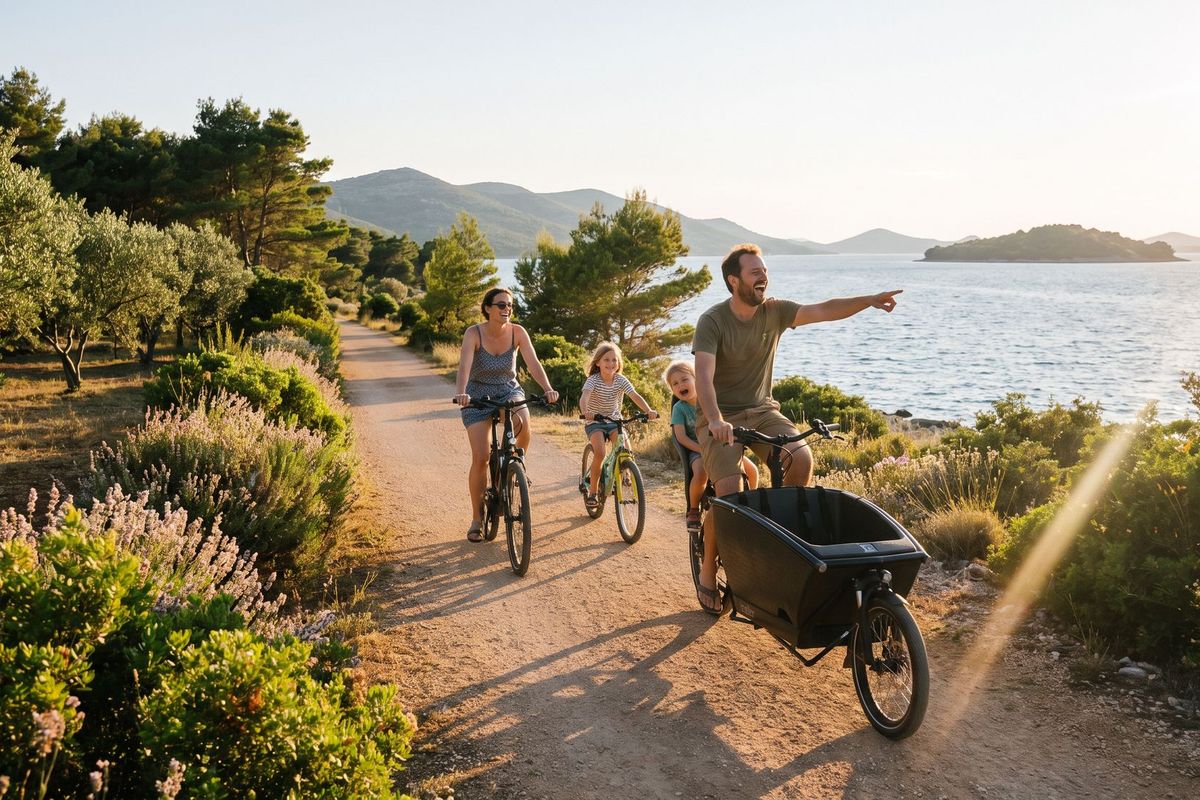
Ionian Family Multi-Adventure by Bike and Boat is the gentlest of the three, an eight-day trip from Corfu built around families. Alongside easy daily rides it mixes in walking, canoeing and plenty of swimming in clear water, taking in Lefkas, Fiskardo on Cephalonia, the Melissani Cave and the quieter islands of Meganisi and Paxos. It carries the lowest difficulty rating and is the one to look at if you are travelling with children.
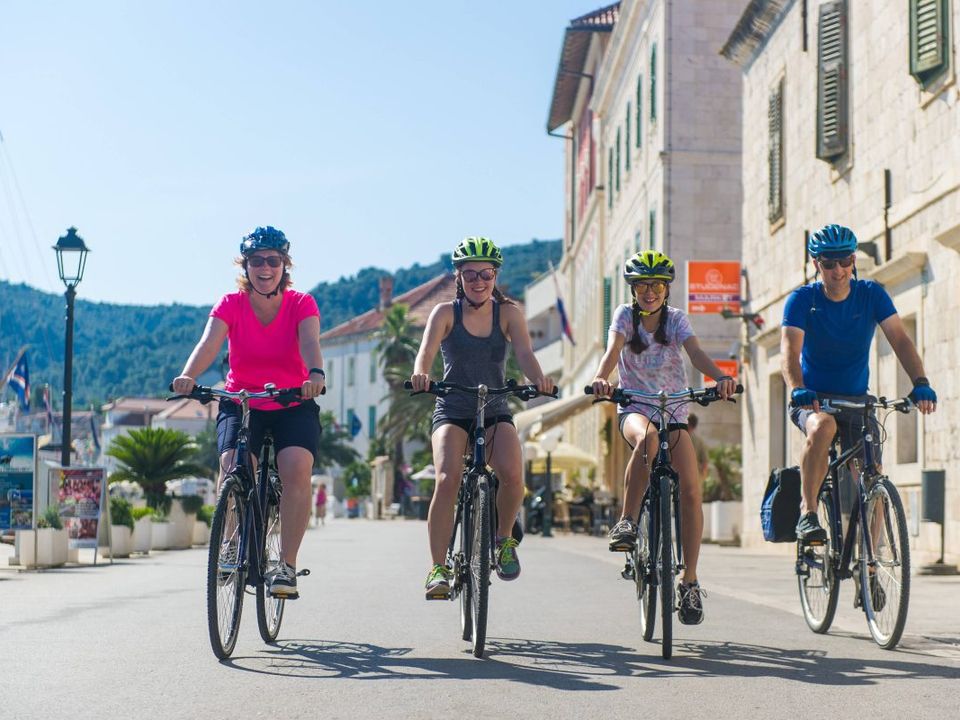
Explore the Ionian Islands by traditional yacht, bike, on foot and by canoe on an eight day adventure from Corfu, with gentle daily rides, swims and family friendly activities in crystal clear Greek waters.
The Peloponnese and Saronic Islands (Luxury) is an eight-day e-bike-and-boat tour from Athens aboard a deluxe motor yacht, threading the Saronic islands and the Peloponnese coast past ancient temples and car-free harbours. The e-bikes and the comfortable vessel make it the pick for those who want the history and the scenery without the hardest climbs.
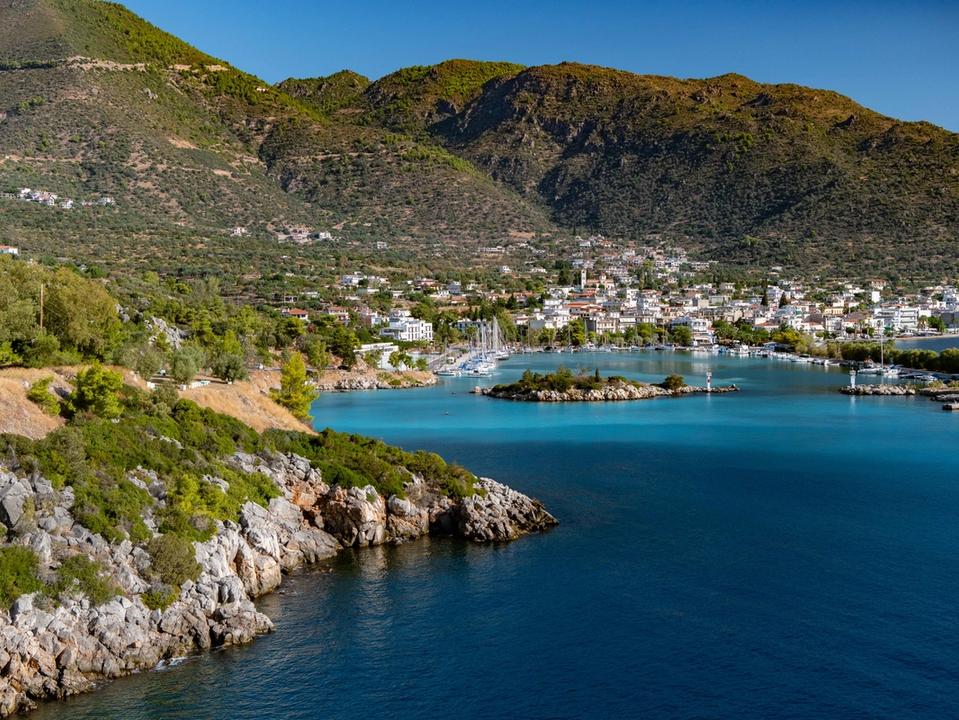
Explore the Peloponnese and Saronic Islands by e-bike and boat. Discover ancient sites, coastal villages, and crystal-clear waters on this guided Greek adventure.
Greek bike-and-boat holidays typically sit around the £3,000 mark per person, which puts them alongside a good guided week in Italy or France. Browse the full Greece collection to compare dates, boats and difficulty ratings side by side.
A few practicalities separate a smooth Greek cycling holiday from a stressful one.
What is usually included. On most bike-and-boat tours the price covers your cabin, the bike or e-bike, a guide on guided departures, and the majority of meals — typically breakfast and lunch on board, with some dinners ashore at your own choice. Always check the exact meal arrangement and whether e-bikes carry a supplement, as these vary by operator.
What to pack. Sun protection is the priority — high-factor cream, a cap under the helmet, and sunglasses. Bring swimwear you can put on quickly, because the swim stops are constant. Pack a light layer or windproof for evenings on deck and for early-season mornings, which can be cooler on the water than the daytime heat suggests. Cycling shoes, gloves and a small day bag round it out.
Seasickness, honestly. The Ionian is generally sheltered and calm, and most people never think about the sea state. The open Aegean and Cyclades crossings can be rougher, particularly when the meltemi blows in summer. If you are prone to motion sickness, favour the Ionian, and bring remedies regardless. Most crossings are short and taken in daylight, which helps.
Booking with confidence. Because a Greek trip is a meaningful outlay, it is worth booking through a route that protects your money. Bookings made through Pedal Ventures are covered by PTS financial protection, so your payment is safeguarded if something goes wrong with the operator before you travel. That matters more at this price point than at the cost of a weekend away.
When to book. Popular boats and cabins on the best May, June and September departures sell out months ahead, and many travellers start planning in the new year for the season to come. If you have a fixed week, book early; if you are flexible, the shoulder-season dates in October often have the best availability.
Before you travel, it is also worth a quick read of the current FCDO travel advice for Greece for entry requirements and any regional notes.
You need a reasonable level of everyday fitness, but you do not need to be a trained cyclist. Daily distances on most island tours are 15 to 40 kilometres, and the option to ride a shorter version is common. The main challenges are hills and heat rather than distance, so if either concerns you, choose a gentler region like the Ionian or opt for an e-bike, which removes most of the difficulty.
Yes, and in Greece it is often the smart choice. E-bikes are widely available on Greek tours and are especially worth it in hillier regions such as the Cyclades and the Peloponnese, where the climbs and the heat combine. Some tours, including our Peloponnese and Saronic Islands route, are run entirely on e-bikes. Check whether an e-bike is included or carries a supplement when you compare tours.
A bike-and-boat holiday uses a boat as your floating hotel while you cycle each day. You sleep on board, ride a loop or a point-to-point stretch by day, and the boat moves to the next harbour, carrying your luggage and giving you swim stops along the way. In Greece the boat also solves the problem of infrequent inter-island ferries, which is why the format suits island cycling so well.
Greece can be an excellent first cycling holiday if you choose the right region. The Ionian Islands are moderately hilly with short distances and calm seas, which makes them well suited to first-timers, particularly on the family-oriented tours. Avoid starting with the steep Cyclades unless you are on an e-bike. The bike-and-boat format itself is very beginner-friendly because the logistics are handled for you.
A guided bike-and-boat week in Greece typically costs in the region of £3,000 per person, broadly comparable with a similar guided week in Italy or France. The exact figure depends on the boat's level of comfort, the season, and whether e-bikes and dinners are included. Luxury motor-yacht tours sit at the higher end, while traditional motor-sailer trips are more accessible.
Yes. Family-focused bike-and-boat tours exist specifically for this, combining gentle daily rides with swimming, walking and activities such as canoeing to keep younger travellers engaged. The Ionian is the natural choice for families thanks to its calm waters and easier terrain. Our guide to family-friendly bike and boat tours in Europe covers what to look for in more detail.
Greece works as a cycling destination precisely because the boat does the hard logistical work, leaving you with the good part: the morning ride, the midday swim, and the evening in a harbour town. Whether you are drawn to the green Ionian, the historic Peloponnese, or the dramatic Cyclades, there is a format and a difficulty level to match how you want to ride.