Bike tour
Porto to Lisbon Coastal Tour
Cycle from Porto to Lisbon along Portugal’s Atlantic coast. Discover beaches, fishing villages, Aveiro, Sintra and the lively capital.

Rob
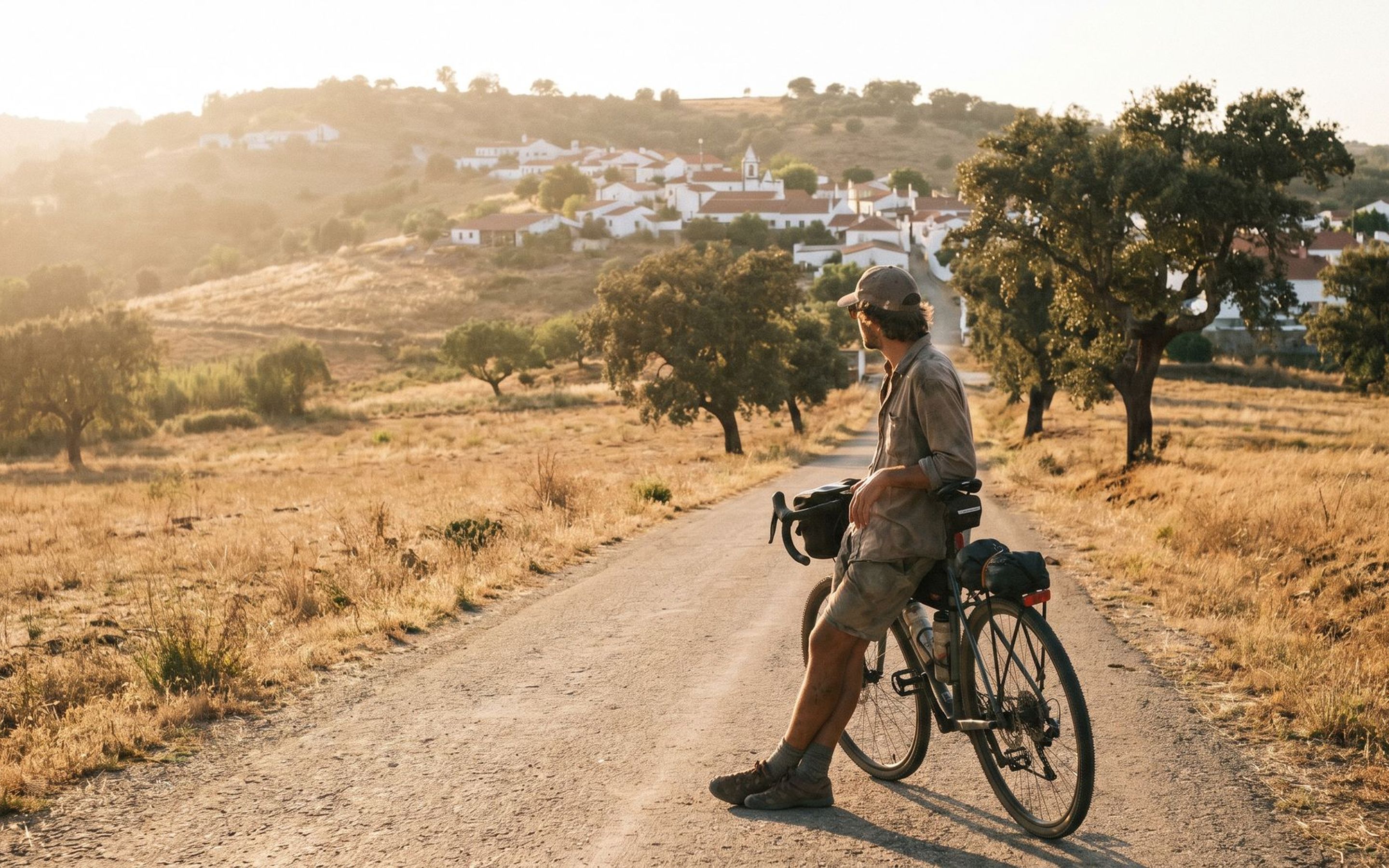
The road from Evora runs south-east through a landscape that barely changes for twenty minutes at a time — golden plains, a scatter of cork oaks with their bark freshly stripped, and a silence so complete you can hear your tyres on the tarmac. Then, just as the rhythm settles, a whitewashed village appears on a hillside, a church bell sounds, and the smell of grilling pork drifts from somewhere you cannot yet see. You pull over. Lunch was not planned here, but lunch is happening here.
This is the Alentejo, and this is what cycling in the Alentejo, Portugal actually feels like — unhurried, generous, and almost entirely free of other tourists. Covering roughly a third of Portugal's landmass but home to less than seven per cent of its population, the Alentejo is the country's great open secret: a region of rolling agricultural plains, cork forests, medieval hilltop towns, and a wine scene that has quietly become one of southern Europe's most exciting. If you have already cycled Tuscany or Provence and want something with the same warmth but none of the crowds, this is where to look next.
Cycle from Porto to Lisbon along Portugal’s Atlantic coast. Discover beaches, fishing villages, Aveiro, Sintra and the lively capital.
Most UK cyclists heading to Portugal think first of the Algarve's coastline or the Douro Valley's terraced vineyards. Both are excellent — we have written extensively about the Algarve's coastal routes. But the Alentejo offers something neither of those regions quite delivers: the feeling of having an entire landscape to yourself, combined with food and wine that can genuinely rival anywhere in southern Europe.
The terrain is forgiving. Daily rides of 40 to 70 kilometres follow quiet backroads through gentle, rolling countryside. There is climbing, but it comes in short, manageable pitches rather than sustained mountain passes. Traffic is minimal — on many Alentejo roads, the most common obstacle is a herd of goats. For couples, food-focused travellers, or anyone who defines a good cycling day by the quality of the lunch stop rather than the elevation gained, this region is close to ideal.
Portugal produces over half the world's cork, and the Alentejo is where most of it comes from. Riding through a cork oak forest — the trees freshly harvested, their trunks a vivid terracotta against the dusty green canopy — is one of those distinctly Portuguese moments that stays with you long after the trip ends.
The Alentejo divides naturally into three cycling zones, each with its own character. Most bike tours in the Alentejo will touch at least two of them.
Evora is the region's cultural heart and the natural starting point for most cycling itineraries. A UNESCO World Heritage Site since 1986, its compact walled centre holds a Roman temple, a striking 16th-century cathedral, and the Chapel of Bones — a macabre but fascinating Franciscan creation lined with human skulls and femurs. It is also home to some of the Alentejo's best restaurants.
From Evora, routes fan out across open plains. The ride south towards Monsaraz — roughly 55 kilometres — is one of the finest day routes in Portugal. The road passes through cork forests and olive groves before climbing gently to Monsaraz itself, a tiny fortified village perched above the Alqueva reservoir. The views from the castle walls stretch for miles in every direction, and the village has a population of fewer than 200 people. It is worth arriving early enough to sit on the ramparts with a glass of Alentejo red before dinner.
Other rewarding rides from Evora include the loop to Arraiolos, known for its traditional wool tapestries and a hilltop castle, and the route east to Estremoz, where the Saturday market fills the main square with local cheeses, sausages, and ceramics.
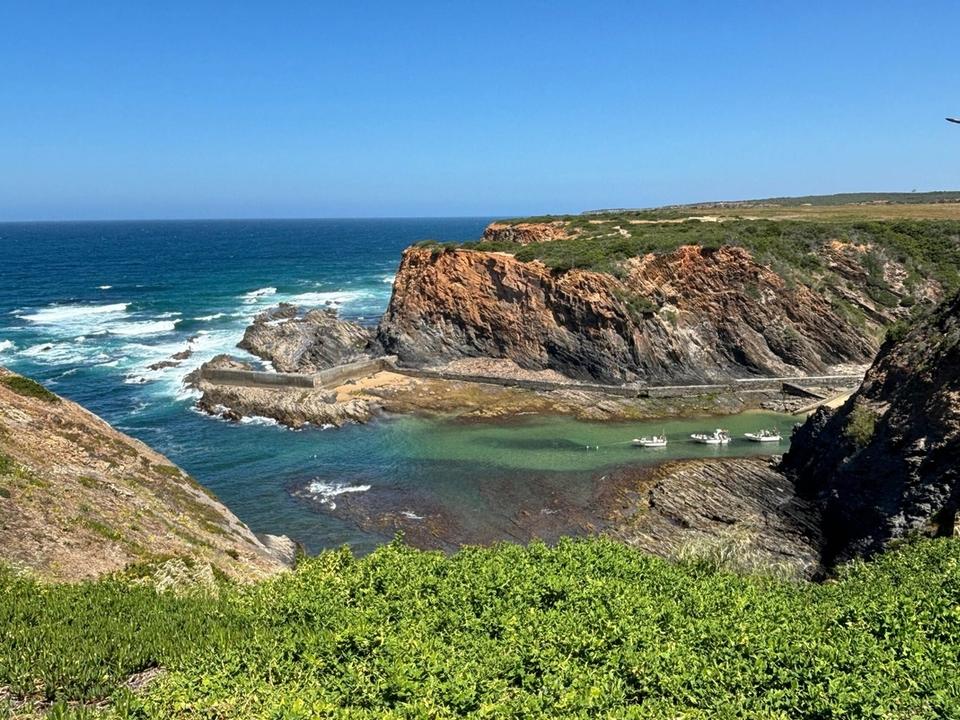
The western edge of the Alentejo meets the Atlantic in a stretch of coastline that feels nothing like the developed Algarve to the south. The Rota Vicentina — a network of walking and cycling trails — runs through the Alentejo's Vicentine Coast Natural Park, where cliffs drop to empty beaches, white storks nest on sea stacks, and development is tightly controlled.
Cycling this coastal section adds a dramatic counterpoint to the inland plains. The terrain is hillier here, with short, sharp climbs away from the shore, but the rewards are considerable: wild beaches accessible only on foot, fishing villages where the daily catch arrives mid-morning, and some of Portugal's most striking coastal scenery. Porto Covo and Vila Nova de Milfontes are the main settlements, both small, both welcoming, and both offering excellent fresh seafood.
Pedal Ventures' Lisbon to the Algarve tour follows the Atlantic coastline and passes through the Alentejo's coastal zone, combining the region's serene countryside cycling with this wilder coastal drama. The route takes in UNESCO-listed towns, rural farmlands, and the beauty of Portugal's western edge. You can explore this tour in full on our Portugal page.
Cycle from Lisbon to the Algarve: 7 days of coastal beauty, historic towns, and scenic routes through Portugal's diverse landscapes.
North of Evora, the landscape changes. The plains give way to low granite hills, and the towns here — Elvas, Marvao, Castelo de Vide — sit on or near the Spanish border, their architecture shaped by centuries of military tension. Elvas is a UNESCO-listed garrison town whose star-shaped fortifications are among the best preserved in Europe. Marvao, perched at over 800 metres, is reached by a climb that earns its views — on a clear day, you can see into Spain.
This section is quieter and slightly more demanding than the central Alentejo, with daily distances of 50 to 65 kilometres and more consistent climbing. It suits cyclists who enjoy a sense of remoteness and who want to combine riding with cultural exploration. The Upper Alentejo also has some of the region's best rural accommodation — converted farmhouses and manor houses that have been running for decades, long before agritourism became fashionable elsewhere in Europe.
If you have been paying attention to Portuguese wine over the past decade, you will already know that the Alentejo is the story. While the Douro Valley remains synonymous with Port, the Alentejo has emerged as Portugal's most dynamic table wine region — producing rich, full-bodied reds and increasingly impressive whites at prices that make equivalent bottles from Tuscany or the Rhone look steep.
The region accounts for roughly a third of Portugal's total wine production. The climate — hot, dry summers and mild winters — suits robust grape varieties like Aragonez (known as Tempranillo in Spain), Trincadeira, and Alicante Bouschet. The whites, often made from Antao Vaz or Arinto grapes, are crisp and aromatic, a welcome discovery for riders at the end of a warm day.
What makes this wine country particularly rewarding for cyclists is its accessibility. Many of the Alentejo's best producers welcome visitors without the advance booking requirements that can make wine tourism in Bordeaux or Tuscany feel like a logistics exercise. Herdade do Esporao, one of the region's flagship estates near Reguengos de Monsaraz, has a restaurant, tasting room, and olive oil production all open to visitors. Smaller estates dot the back roads between Evora and Monsaraz, many offering informal tastings for a few euros.
A bike tour through Alentejo wine country is not about ticking off prestigious appellations. It is about the pleasure of arriving at a small adega in the late afternoon, sitting in the shade of a vine-covered terrace, and tasting wines that cost three or four euros a glass but would hold their own against bottles at three times the price elsewhere in Europe. This is the cycling holiday the Foodie Cyclist has been waiting for.
The Alentejo's cuisine is rural, generous, and deeply seasonal — built around pork, bread, olive oil, wild herbs, and whatever the land provides. It is Portugal's most distinctive regional food tradition, and it rewards hungry cyclists generously.
The dishes to look out for include:
Portion sizes are substantial. Restaurants in the Alentejo tend to serve what British visitors would consider a starter, a main, and a dessert for prices that seem almost apologetic — often under 15 euros for a full meal with wine. This is one of the few regions in western Europe where eating out twice a day on a cycling holiday does not require a second mortgage.
The Alentejo's continental climate means timing matters more here than on the Portuguese coast.
Spring (March to May) is the prime window. Temperatures sit between 18 and 25 degrees Celsius, the plains are green from winter rain, and wildflowers — poppies, lavender, cistus — cover the roadsides. Easter week brings local festivals and processions to many towns, adding cultural interest without overcrowding routes.
Autumn (September to November) is equally strong, particularly from mid-September onwards when the grape and olive harvests are underway. Temperatures remain warm at 20 to 28 degrees, the light turns golden, and the wine estates are at their most active. Late October brings the cork harvest in some areas, a fascinating process to witness from the roadside.
Summer (June to August) requires caution. Inland temperatures regularly exceed 35 degrees Celsius and can touch 40 in July and August. Cycling is possible with very early starts — on the road by 7am, finishing by noon — but the heat is a genuine consideration, particularly for leisure riders. The coast remains more comfortable thanks to Atlantic breezes.
Winter (December to February) is mild compared to northern Europe, with daytime temperatures of 12 to 16 degrees, but rain is more frequent and some rural accommodation closes for the season. It is cyclable but not ideal for a first visit.
For most riders, late April or early October hits the sweet spot: warm enough for comfortable riding, cool enough for long lunches outdoors, and perfectly timed for either spring colour or autumn harvest.
The Alentejo is one of Portugal's most accessible cycling regions. The terrain is predominantly rolling — not flat, but never steep for long. A typical day involves 40 to 70 kilometres on quiet rural roads with a total elevation gain of 300 to 500 metres. This places most Alentejo routes firmly in the easy to moderate category.
The roads themselves are generally well-surfaced, though some secondary routes between smaller villages may have rougher sections. Traffic outside Evora and a handful of larger towns is negligible. It is common to ride for 20 or 30 minutes without seeing a car.
E-bikes are an excellent option here, particularly for couples with different fitness levels or for anyone who wants to extend their range into the hillier Upper Alentejo without turning the holiday into a workout. The gentle gradients and quiet roads make this region particularly well suited to riders who are confident on a bike but do not consider themselves sporty.
For those wanting more challenge, the routes around Marvao and the Serra de Sao Mamede Natural Park offer proper climbing — 600 to 800 metres of elevation gain over a day — with the reward of some of the Alentejo's most dramatic scenery.
Portugal offers remarkable variety for a relatively small country. Understanding where the Alentejo sits helps in choosing the right region.
The Algarve is Portugal's most popular cycling destination, known for its coastal routes, reliable sunshine, and well-developed tourist infrastructure. It is busier, more developed, and more coastal in character. If you want beaches, seafood restaurants on the harbour, and the widest choice of accommodation, the Algarve delivers. If you want solitude and a deeper cultural experience, the Alentejo is the better fit.
The Douro Valley offers Portugal's most dramatic cycling landscape — terraced vineyards, river gorges, and significant climbing. It is more physically demanding than the Alentejo and more focused on a single product (Port wine) than a broader food and wine culture. The Douro suits confident cyclists who enjoy a challenge; the Alentejo suits those who prefer their cycling at a gentler pace.
Lisbon and the surrounding coast make a strong add-on to an Alentejo trip. Many riders begin or end in the capital, spending a day or two exploring the city before heading south-east into the Alentejo's open country.
For a broader look at cycling across the country, our Portugal cycling holidays page covers all regions and current tour availability.
Cycle Portugal's Eastern Algarve: 4-day self-guided tour through Tavira, Olhão, and Ria Formosa, featuring coastal views and cultural stops.
Lisbon's Humberto Delgado Airport is the most convenient arrival point, with frequent direct flights from London, Manchester, Birmingham, and Edinburgh. The Visit Portugal site has useful regional information for planning your trip. Evora is roughly 130 kilometres east of Lisbon — around 90 minutes by car or shuttle transfer. Some tours begin in Lisbon and include the transfer to the Alentejo as part of the itinerary.
Pack for warm, dry weather with cooler evenings. Sun protection is essential from April onwards — the Alentejo's open plains offer little shade. A light windproof layer is useful for early mornings and for the coast, where Atlantic breezes can be fresh. Padded cycling shorts, a comfortable jersey, and a good pair of sunglasses will cover most days.
All cycling holidays booked through Pedal Ventures are PTS-protected, meaning your money is financially secure even if an operator or Pedal Ventures itself were to fail. At an average booking value of around £3,000, this protection matters. We are a marketplace — we connect you directly with handpicked local operators who know the Alentejo's roads, the best places to stay, and the restaurants that do not appear in guidebooks. We do not run tours ourselves; we curate them. If we would not book it for our own holiday, it is not on the site.
Browse Alentejo cycling holidays on Pedal Ventures to see current availability, difficulty ratings, and detailed itineraries.
Yes. The rolling terrain, quiet roads, and manageable daily distances of 40 to 70 kilometres make the Alentejo one of Portugal's most beginner-friendly cycling regions. E-bike options reduce the physical demand further. The main consideration is heat in summer — beginners should aim for spring or autumn.
Self-guided cycling holidays work very well in the Alentejo. The road network is straightforward, signposting is adequate on main routes, and GPS navigation handles the quieter back roads. Luggage transfer between accommodations is arranged by local operators, so you ride with a daypack only. The region's safety and low traffic make it comfortable for self-guided riders.
A week-long self-guided cycling holiday in the Alentejo typically costs between £1,200 and £2,500 per person, depending on accommodation standard and inclusions. This generally covers accommodation, luggage transfers, route notes or GPS files, and some meals. Flights and travel insurance are usually booked separately. Daily spending on food and wine in the Alentejo is notably lower than in comparable regions of Italy or France — expect to pay 10 to 20 euros for a generous restaurant lunch with wine.
Evora is the obvious choice — central, well-connected, and rich in restaurants, historical sites, and accommodation options. From Evora, you can reach most of the Alentejo's key cycling routes within a short transfer. For riders focused on the coast, Vila Nova de Milfontes offers a smaller, quieter base with direct access to the Rota Vicentina trails.
You do not need one, but many riders appreciate the option. The Alentejo's terrain is manageable on a standard touring bike or hybrid, but an e-bike extends your daily range, smooths out the rolling hills, and leaves you fresher for the evening — which, in a region this focused on food and wine, is arguably the point.
Portugal is widely regarded as a safe country for cyclists. The Alentejo's quiet rural roads carry very little traffic, and drivers are generally respectful of riders. The UK Foreign, Commonwealth and Development Office (FCDO travel advice for Portugal) does not flag any specific safety concerns for the region. Standard precautions apply: wear a helmet, carry water, and let someone know your route for the day.