Bike tour
Amsterdam to Bruges: Canals and Culture
Explore Holland and Belgium by bike and boat: 8 days of flat cycling, cultural highlights, and scenic waterways from Amsterdam to Bruges.

Rob

Ask most people to picture cycling in Belgium and you get one image: flat. Cobbled lanes across Flanders, canal paths out of Bruges, the wind coming off the North Sea with nothing to stop it. It is a fair picture of the north. It is also only half the country.
Drive an hour south of Brussels and the land begins to fold. This is the Ardennes — the forested, hill-carved south of Wallonia, where rivers have cut deep valleys and the roads climb instead of running arrow-straight. For cycling holidays in Belgium, it is the region that quietly upends the flat-country reputation. If Flanders is about distance and wind, the Ardennes is about gradient and forest, and the two make for genuinely different holidays.
Explore Holland and Belgium by bike and boat: 8 days of flat cycling, cultural highlights, and scenic waterways from Amsterdam to Bruges.
Honestly hilly — but not relentlessly so, and that distinction matters. The Ardennes is a plateau of dense woodland cut through by river valleys. Ride along the rivers and the going is gentle, close to flat, following water downhill. Leave the valley floor for the villages and viewpoints on the ridges, and you climb, sometimes sharply.
That gives you a useful dial. A rider who wants an easy week can stay low, tracing the valleys and barely troubling the legs. A rider who wants to be tested can point uphill at every junction and find plenty to work with — short, steep pitches rather than long alpine drags. Most people want something in between.
In practical terms, a comfortable Ardennes day is somewhere around 40 to 55 kilometres. That may sound modest next to a flat Flanders run of 70 or 80, but the numbers are not comparable — a hilly 45 asks more of you than a level 70, and it leaves more time for the citadel, the long lunch and the second coffee. Judge an Ardennes day by its climbing, not its distance.
If the climbing is the one thing giving you pause, this is exactly the terrain an e-bike was made for. The motor turns a wall of a hill into a manageable one, and it lets a mixed-ability couple ride together instead of one person waiting at the top of every rise. Our e-bike holidays exist for precisely this kind of country — where the scenery is worth the height gain but the gradient shouldn't decide who enjoys the day.
The clever way to ride the Ardennes is to let the rivers set the route. The Meuse, the Ourthe and the Semois have each carved a corridor through the plateau, and much of that corridor is now traffic-free.
Wallonia's RAVeL network is the reason. RAVeL stitches together more than 1,350 kilometres of disused railway lines, canal towpaths and byways into signed, largely car-free routes — the kind of surface where you can look up at the citadels instead of down at the tarmac. The Meuse corridor between Namur and Dinant is one of the finest stretches, part of the longer EuroVelo 19 Meuse Cycle Route that follows the river through the heart of the region.
Because the network runs along the valley floors, it gives nervous riders and families a low-stress spine to work from, with the hills there to take on only when you choose to. It is also why the Ardennes suits a self-guided cycling holiday so well — the signing is good, the routes are logical, and you can ride at your own pace with the logistics handled behind you.
There is another Ardennes, though, and keen riders already know it. These hills are cycling heritage. Every spring the peloton comes here for Liège–Bastogne–Liège, the oldest of professional cycling's five Monuments, first raced in 1892 and known to everyone in the sport as La Doyenne — the old lady.
Its most famous climb, the Côte de la Redoute, is a short brute above Remouchamps: roughly 1.7 kilometres at an average of around 9.5 per cent, ramping to 20 per cent near the top. You do not need to be a racer to ride it, and plenty of amateurs make the pilgrimage to see how their legs measure up against a hill they have watched on television for years. The Ardennes is full of these — punchy, wooded climbs with a plaque at the bottom and a view at the top. For a certain kind of cyclist, ticking off a few of them is the whole point of the trip.
It helps to think of Belgium as two cycling countries sharing a border. The north — Flanders — is flat, dense with towns, and built for distance: you link up medieval cities like Bruges and Ghent on level, well-surfaced paths, and the challenge, when there is one, comes from cobbles and wind rather than height. It is superb for first-timers and for anyone who wants to cover ground and see a city most evenings.
The Ardennes trades that for space and gradient. The towns are smaller and further apart, the forest closes in, and the reward is scenery and quiet rather than a cathedral around every corner. Neither is the "real" Belgium — they are two different holidays. If a gentle, city-rich week appeals more, the flat riding around Bruges is the better fit; if you want your legs to know they have been somewhere, head south.
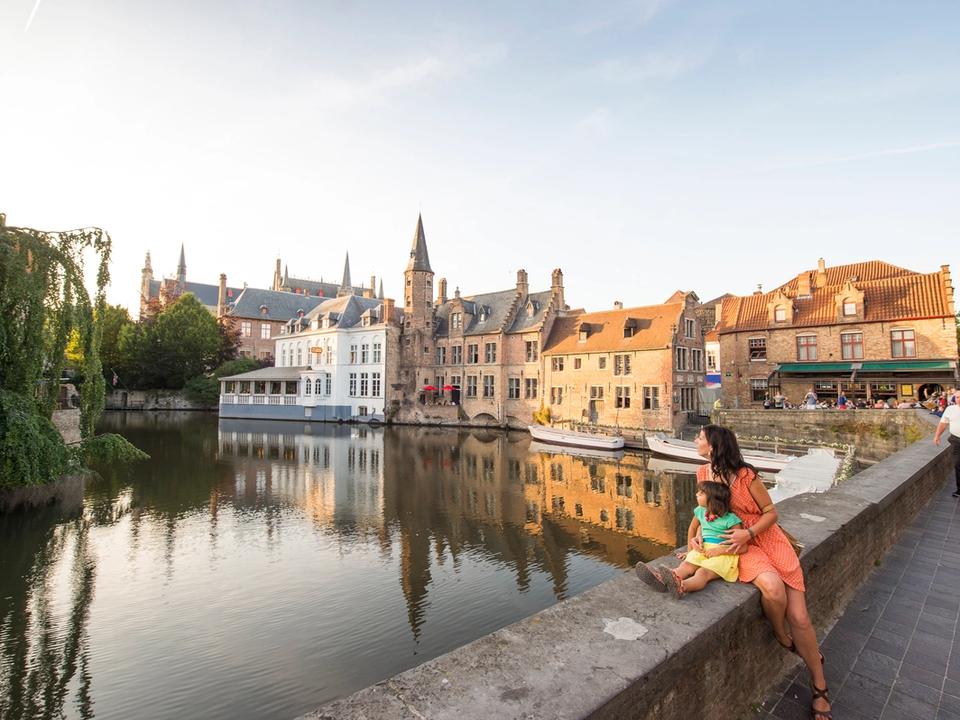
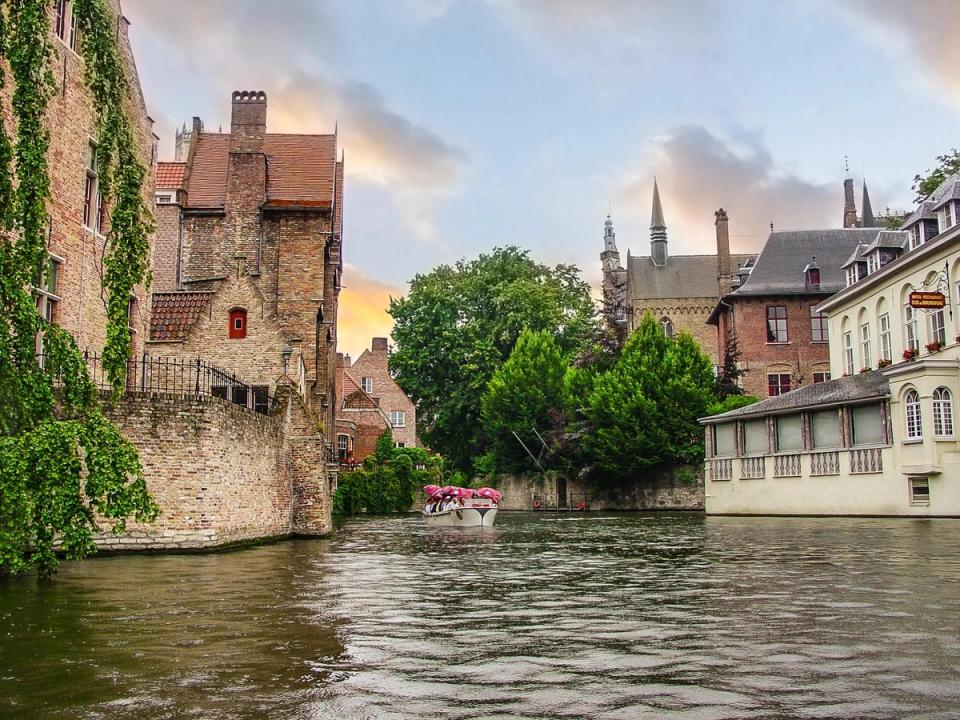
Cycle through West Flanders to explore Bruges, Ieper, and the coast, with WWI history, canals, castles, and Belgian culture.
The riding threads together a run of towns that each earn a stop.
Dinant is the postcard: a slim collegiate church with a bulbous dome, a cliff-face citadel reached by cable car or a great many steps, and the Meuse sliding past below. It is also the birthplace of Adolphe Sax, inventor of the saxophone, which the town will not let you forget and is all the more charming for it.
Bouillon, on a tight loop of the Semois, is dominated by a medieval castle that seems to grow straight out of the rock — one of the best-preserved fortresses in Belgium and a proper leg-stretch to explore on a rest afternoon.
La Roche-en-Ardenne sits deep in the Ourthe valley under its own ruined castle, a walkers' and cyclists' town that makes a natural base for the wooded interior.
Bastogne carries the weight. This is where the Battle of the Bulge was fought over the winter of 1944–45, and the town's memorials and museum make it one of the most affecting stops in the region. Riding in from the forest, past villages that were front lines within living memory, gives the landscape a depth that pure scenery never quite reaches.
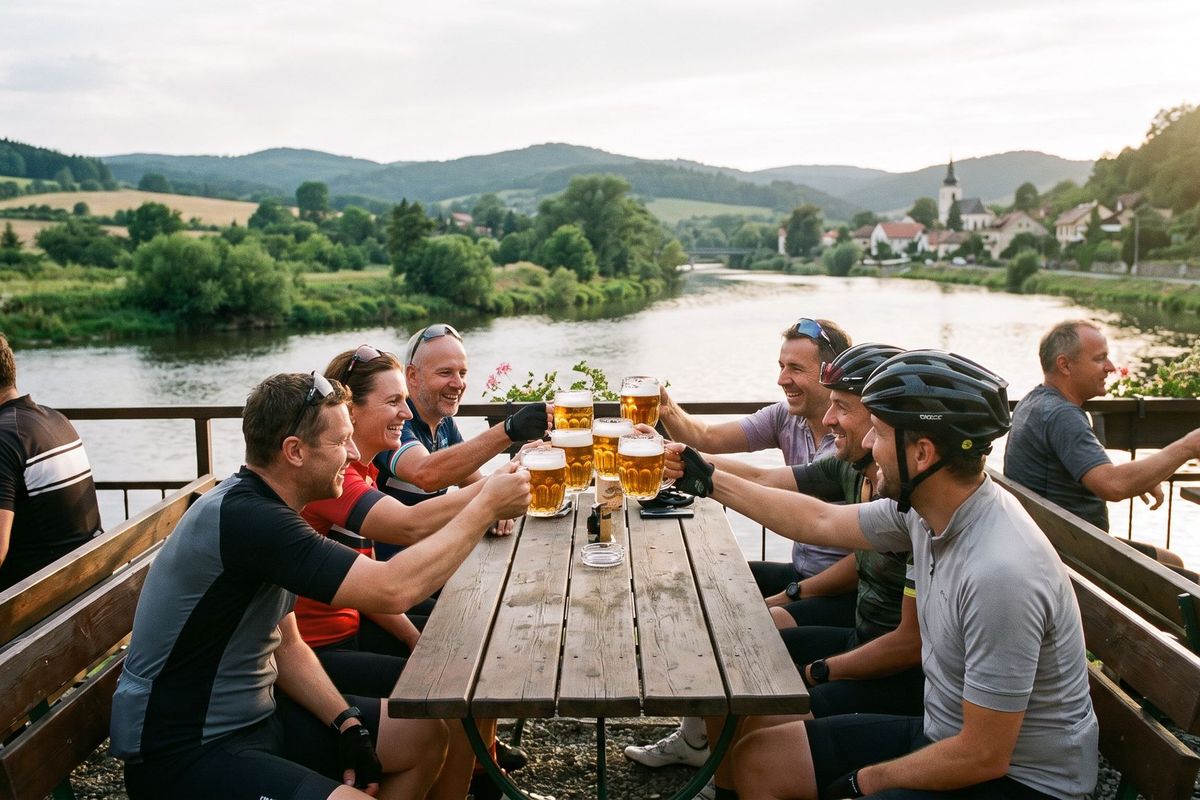
Belgium brews more than 1,500 different beers, and the Ardennes holds some of the most storied. This is abbey and Trappist country, where monastic brewing survived into the present as a genuine, working tradition rather than a marketing story.
The name to know is Orval, brewed at a Cistercian abbey tucked into the Gaume in the far south — a single, distinctive beer whose ruined-abbey setting is worth the detour on its own. Across the region you will find abbey ales poured in village cafés that have watched cyclists come through for a century. Earning that glass with a day in the hills is a large part of why people ride here rather than somewhere flatter and easier.
Late spring through early autumn is the window. May and June bring long days and the forest at its greenest; September and early October trade some daylight for cooler climbing and the first turn of autumn colour through the woods. High summer is fine but busier around the honeypot towns. Whatever the month, this is northern Europe — pack for the chance of rain, and check the FCDO's Belgium travel advice before you travel as a matter of routine.
Who is it for? Active couples who want scenery and a bit of a challenge without going full alpine. Solo riders after quiet, well-signed roads. Anyone drawn to the cycling history. It is a step up from the flat comfort of the Flanders side, and that is the appeal — the Ardennes asks a little more and gives a little more back.
Because an Ardennes trip is a higher-consideration choice than a gentle canal week — more climbing, more moving parts — it is worth booking through a marketplace where every operator is handpicked and your money is protected under the PTS scheme, so the only real decision left is how many hills you fancy.
Ready to see where the Belgian hills could take you? Start with our Belgium cycling holidays, or browse the wider range of cycling holidays across Europe to compare the Ardennes with the rest of the continent's great riding.
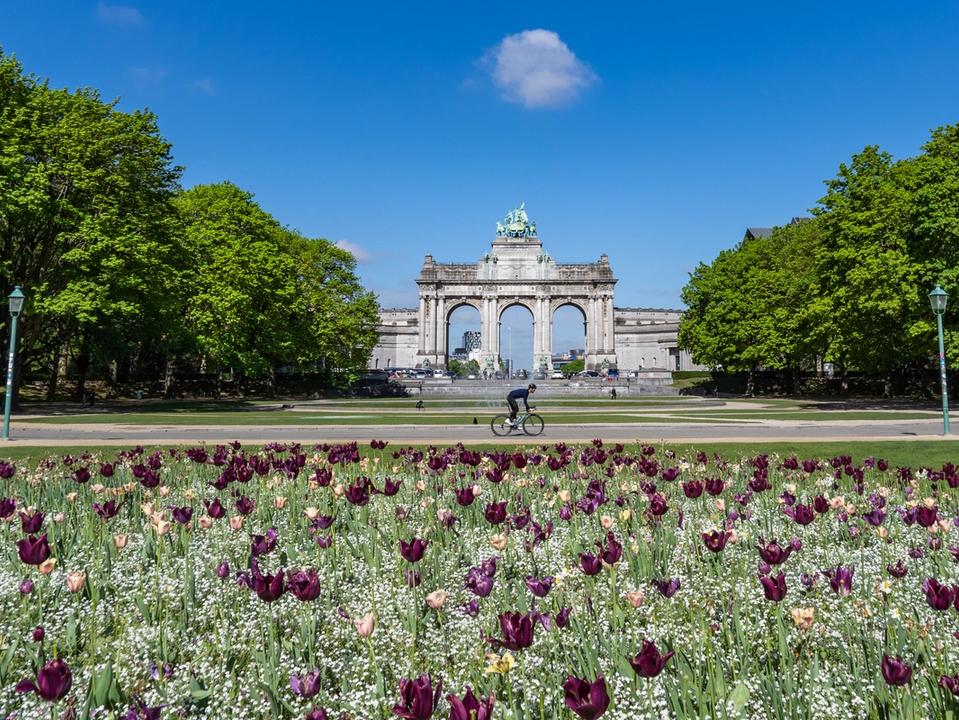
Cycle through Brussels, Ghent and Bruges. Discover Belgium’s history, canals, beer and culture on this unforgettable cycling holiday.