Bike tour
Danube Delta: Romania’s Natural Beauty
Discover Romania’s Danube Delta on a cycling and boat tour. From Tulcea to the Black Sea, experience nature, history, and culture.

Rob
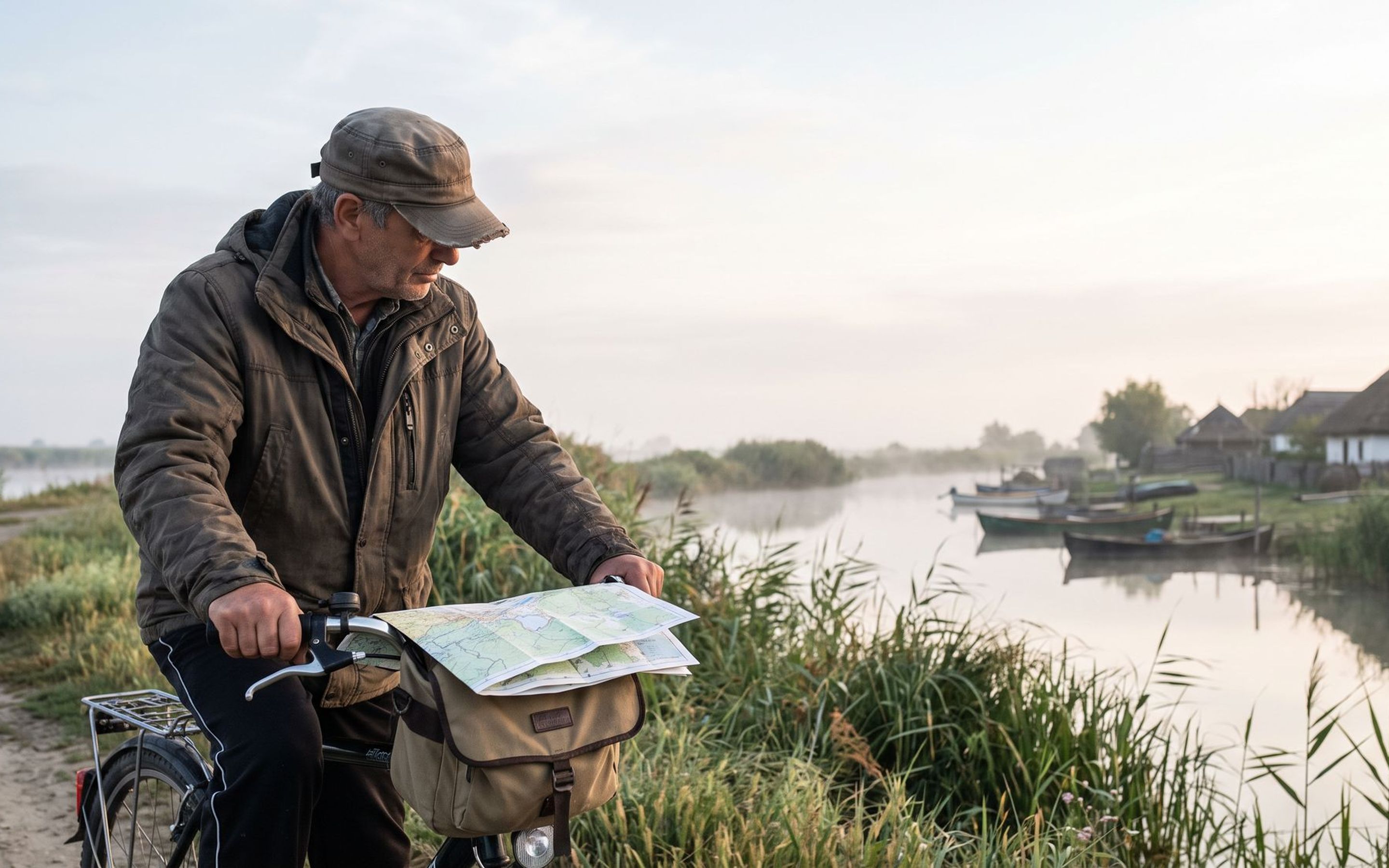
Most people picture a cycling holiday as a line on a map: a route you follow from one town to the next, with your luggage waiting at the far end. The Danube Delta does not work like that, and the riders who get the most from it are the ones who understand why before they book. You do not ride the delta in a straight line. You ride it in pieces — flat stretches of dyke and village lane — with a boat doing the joining up.
That single fact shapes everything else about the trip. Learning how to cycle the Danube Delta is less about training for hills and more about understanding a landscape where water, not tarmac, is the main road. Get that straight early and the rest of the planning falls into place quickly.
Because there is barely anywhere to ride to in the usual sense. The delta covers roughly 4,152 square kilometres where the Danube finally meets the Black Sea — the second-largest and best-preserved river delta in Europe, and a UNESCO World Heritage Site since 1991. Most of that area is reed bed, lagoon and shifting channel rather than solid ground, and more than 320 bird species live in it. There is no network of roads crossing the middle of it, and there was never meant to be.
What the delta does have is a scatter of firm edges: raised dykes, fishing villages such as Crișan and Mila 23, and the long spit of land running out to Sulina on the coast. These are where you cycle. To get from one to the next you travel by water, which is exactly how the people who live here have always moved. The riding is genuinely lovely and genuinely limited — and that is the point of going by boat.
On a well-run trip the boat is your hotel as well as your transport. You unpack once, somewhere near Tulcea, and from then on the vessel moves with you — mooring near a village, waiting while you ride a loop of dyke and lane, then carrying you and the bikes on to the next stretch of water while you eat lunch on deck. Pedal Ventures lists a boat-and-bike holiday in the delta, Danube Delta: Romania's Natural Beauty, that runs on roughly this eight-day shape, from Tulcea out towards the Black Sea and back.
Discover Romania’s Danube Delta on a cycling and boat tour. From Tulcea to the Black Sea, experience nature, history, and culture.
It is a rhythm that suits a particular kind of rider: someone who likes the idea of a floating base, short active mornings, and long slow afternoons watching pelicans rather than chasing a daily mileage. If that sounds closer to a river cruise with bikes than a cycling challenge, you have understood it correctly. The format belongs to the wider family of bike-and-boat holidays, and the delta is one of the places it makes the most sense.
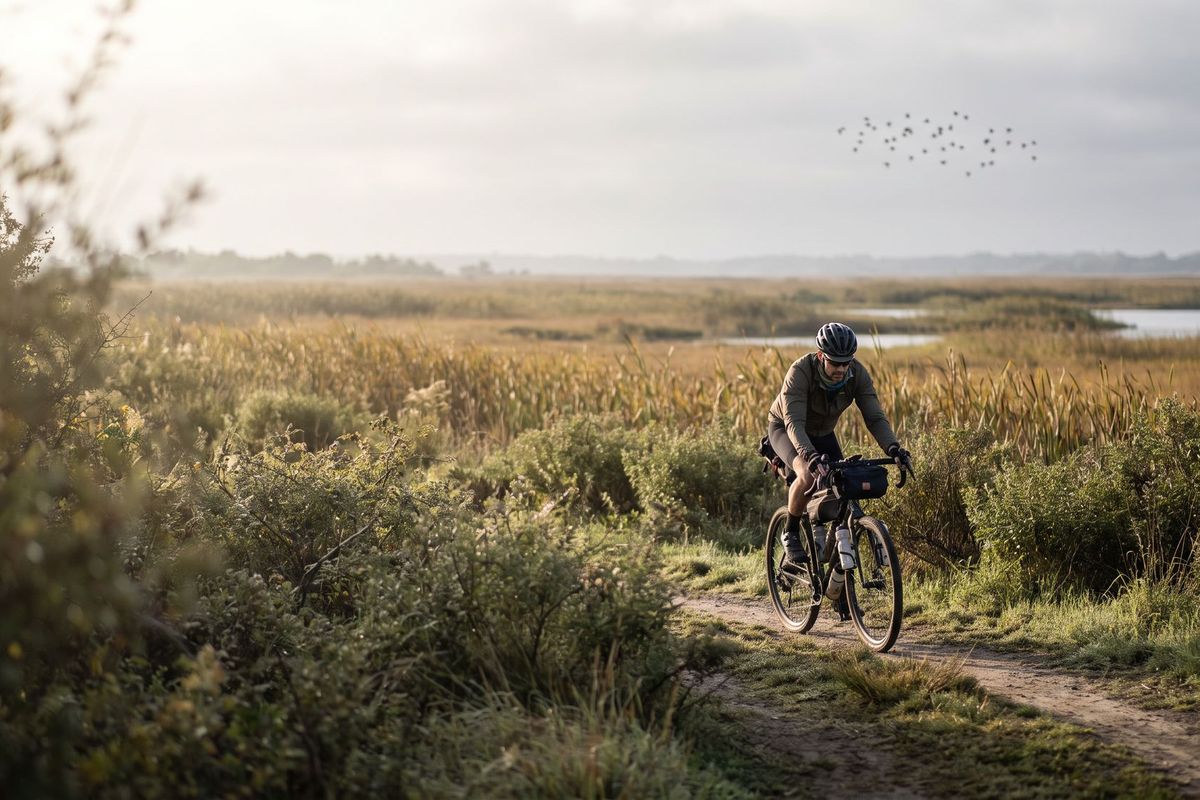
A day tends to fall into two unhurried halves. You ride in the cooler morning — a flat loop of maybe 20 to 35 kilometres along a dyke or between villages, stopping for water buffalo, fishermen mending nets, and whatever has landed on the lagoon. By early afternoon you are back on the boat for lunch, and the vessel repositions while you rest, read, or simply watch the reeds slide past. Some trips add an optional second ride or a walk ashore later in the day; others leave the afternoon deliberately empty.
The landscape does change as you go, which keeps the short distances interesting. The Letea forest, out towards the coast, is known for its sand dunes and semi-wild horses; Sulina, at the eastern end, still has the old lighthouse and a cosmopolitan harbour past; and the vast Razim lagoon system to the south feels more like an inland sea than a river. You are not covering big miles, but you are moving through genuinely distinct places.
Almost everyone starts in Bucharest. You fly into Henri Coandă airport, and from there it is a road transfer of roughly three and a half to four and a half hours east to Tulcea, the town that acts as the delta's front door. On an organised trip that transfer is arranged for you at both ends — typically day one out to the boat, and the final day back to the city — so you are not left working out rural bus timetables with a bike bag over your shoulder. It is worth checking the FCDO's Romania travel advice before you travel, for entry requirements and any regional notes.
Tulcea itself is where the paved world stops and the water world begins. It sits at the point where the Danube splits into its three main arms, and every boat into the delta leaves from here or close by. Independent travellers can reach Tulcea by bus or train from Bucharest, but the harder part is what comes next: arranging a boat, a guide and bike hire once the roads run out. That is the stage where a packaged trip earns its keep.
Less than you might fear. This is some of the flattest cycling in Europe — there is simply no gradient to speak of in a river delta — so raw fitness is rarely the thing that catches people out. Daily distances on delta trips are modest and the pace is relaxed, which is why the format works well for mixed-ability couples and for anyone returning to a bike after a few years away.
The real challenges are different in kind. Summer heat on an exposed dyke can be draining, there is little natural shade, and services are thin once you are deep in the reserve, so you ride with what you brought. Wind across open water can turn an easy flat stretch into honest work, much as it does on the wider Danube. None of this is difficult to manage — it just rewards sensible preparation more than a training plan. If you want a feel for the landscape before you commit, our earlier piece on exploring Romania's delta by bike sets the scene.
Pack for sun, water and wildlife rather than for mountains. The essentials earn their place quickly:
You will not need the paraphernalia of a self-supported tour. On a boat-and-bike trip the vessel carries your luggage, and bikes, including e-bikes on many trips, are usually provided, so you are travelling lighter than on a point-to-point ride.
Because the delta is one of the few European rides where going independent is genuinely harder than it looks. You are inside a protected biosphere reserve with restricted access in places, few roads, limited English in the villages, and a logistical puzzle — boat, guide, bikes, permits and accommodation — that has to line up before you turn a pedal. Solving all of that from the UK, for a week, is a large job for a modest holiday.
This is where a curated marketplace helps. Pedal Ventures does not run the boats itself; it connects you to the local operators who already know the channels, the moorings and the seasons, and every trip is hand-picked rather than listed by volume. Because a delta holiday is a high-consideration booking of around £3,000, it is worth knowing your money is PTS-protected if either the operator or Pedal Ventures were to fail before you travel. That protection is quietly reassuring on a trip this remote.
If the Danube Delta is on your list for next year, the practical takeaways are simple: fly to Bucharest, let someone else handle the Tulcea transfer and the boat, pack for sun and insects rather than climbs, and judge the trip by its birds and its evenings rather than its mileage. You can see the current itinerary and dates on the Danube Delta cycling page, or step back and compare it with the rest of our Romania cycling holidays to see how the delta fits the wider country.