Bike tour
Vietnam Adventure - Bike & Boat from North to South
A journey through Vietnam’s landscapes, culture, and cuisine by land and water. Discover hidden villages, vibrant cities, and spectacular scenery by bike and boat.

Rob
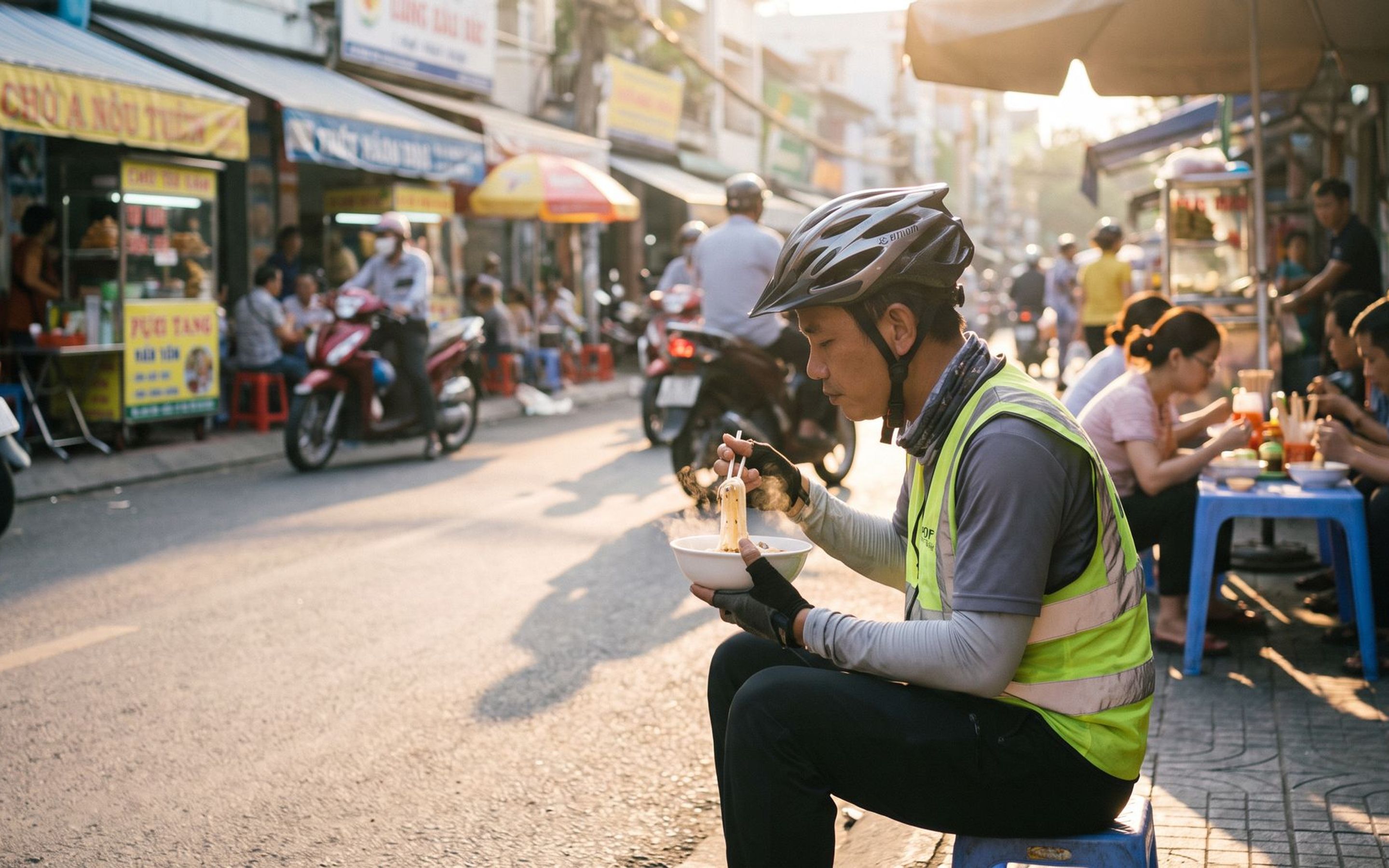
In Vietnam, the best meals are eaten six inches off the ground, on a plastic stool at the edge of the road, from a pot that has been simmering since before dawn. There is no menu, no booking, and usually no English. There is just a woman with a ladle, a queue of locals who know exactly what they are queuing for, and a bowl that arrives in front of you fragrant with star anise and lime. A bicycle is the fastest way to find places like this — and the slowest, which is the point.
That combination is why cycling Vietnam for the food works so well. A coach sails past the stool. A car can't stop at it. On a bike you smell the charcoal two corners before you reach it, you have somewhere to lean the frame, and you have the appetite of someone who has spent the morning pedalling between rice paddies. You eat differently when you have earned it. This is a ride you measure in meals as much as in miles, running the length of the country from the noodle stalls of Hanoi to the floating markets of the Mekong.
Vietnamese food rewards the hungry and the unhurried, and cycling makes you both. The country's signature tours are rated leisurely for a reason: the riding is mostly flat, the days are built around stops rather than distances, and e-bikes are there if you'd rather save your legs for the evening. You arrive at lunch warmed up and ravenous, not wrecked — which matters when lunch is the day's main event.
It also puts you in the right places at the right times. Breakfast is Vietnam's underrated meal, eaten early and on the street, and a cyclist is already out in it while the tour buses are still at the buffet. You roll through vegetable villages as the beds are being watered, reach river markets while the trading is still in full swing, and pass the roadside grills exactly when the coals are hottest. On a bike and boat holiday the rhythm tightens further: you cycle the land, then eat and sleep on the water, waking up somewhere new and hungry again.
Start where the country starts, in the old quarter of Hanoi, where the cooking spills onto the pavement and the traffic organises itself around it. The dish to find first is phở — the clear, slow-built beef or chicken noodle soup that Hanoi claims as its own, served plainer here than the herb-piled southern version, because northerners trust the broth to carry it. Then there is bún chả: smoky pork patties and belly grilled over charcoal, dropped into a bowl of sweet-sharp dipping sauce with a tangle of cold rice vermicelli and a fistful of herbs. You assemble each mouthful yourself. It is lunch as a small, delicious piece of admin.
For something cooked in front of you, seek out chả cá — turmeric-and-dill marinated fish finished in a sizzling pan at your table with spring onions and a shower of peanuts, a dish so tied to one Hanoi street that the street took the restaurant's name. It is the sort of local institution a bike makes easy to reach down a lane no coach could enter.
Hanoi's strangest pleasure is a drink. Cà phê trứng, or egg coffee, is a cup of strong Vietnamese coffee topped with a whipped cloud of egg yolk and condensed milk — closer to drinking tiramisu than anything you'd call a flat white. It was reputedly invented in 1946, when a bartender named Nguyễn Văn Giảng answered a wartime milk shortage by whisking egg into the cup instead, and his family still pour it in a hard-to-find Hanoi café today (Vietnam News). Order one after a morning's ride and it doubles as pudding.
South of the capital the landscape opens into the limestone country around Ninh Bình, where the cooking turns rustic and regional. This is goat country — dê núi, mountain goat, served grilled with lemongrass or wrapped in fig leaves — eaten within sight of the karsts you've just cycled beneath. It is the kind of lunch you only hear about because a local operator put it on the route, and the kind generic itineraries miss entirely.
Keep heading south and the food changes with the light. Vietnam is a long, thin country — more than 1,600 kilometres top to bottom — and its kitchens shift as you ride, getting sweeter, spicier and more herb-heavy the further south you go. The bike makes that gradient something you taste by the day rather than read on a map.
If Vietnam has a culinary capital for cyclists, it is Hội An, the lantern-lit former trading port on the central coast whose old town has been a UNESCO World Heritage site since 1999 (UNESCO). Its centuries as a meeting point for Chinese, Japanese and European traders are still on the plate, and most tours build in a cooking class here — the kind of afternoon that turns a holiday into a skill you take home.
A journey through Vietnam’s landscapes, culture, and cuisine by land and water. Discover hidden villages, vibrant cities, and spectacular scenery by bike and boat.
The best of those classes start in the saddle. A short ride out of town brings you to Trà Quế, a riverside herb village where the gardens have been worked the same way for generations and visitors are put to work raking beds and stirring the soil before they're allowed near a wok. You cycle back with your own basket of herbs and cook them the same day.
Then there is the dish that refuses to travel. Cao lầu — thick, chewy noodles with slices of pork, crisp croutons and a little rich broth — is made properly only in Hội An, traditionally using water from the old Cham-era Ba Lễ well and lye from wood ash, a combination cooks who move away say they simply cannot reproduce ([EDITORIAL — VERIFY]: CNN Travel or Atlas Obscura feature on cao lầu and the Ba Lễ well — search "Hoi An cao lau well water"). Alongside it, order "white rose" dumplings — translucent shrimp parcels folded to look like petals — and a bánh mì, the baguette Vietnam inherited from the French and improved out of recognition, from one of the town's famous bread carts. Eat all three in an afternoon and you'll understand why riders plan whole trips around this one small town.
North of Hội An the road climbs the Hải Vân Pass — the "Ocean Cloud Pass", the one proper test on an otherwise gentle route, and skippable by support vehicle if the legs aren't willing. On the far side lies Huế, Vietnam's former imperial capital, and the cooking carries itself accordingly. This was the court's kitchen, where meals were served as many small, precise dishes so the emperor could taste a little of everything. The everyday legacy is bún bò Huế, a lemongrass-and-chilli beef noodle soup with a deeper, fierier punch than its Hanoi cousin — the reward for the morning's climb, eaten looking out over the Perfume River.
The country's final act is its flattest and, for a cyclist, its most purely enjoyable. In the Mekong Delta the roads are level, shaded and lined with fruit — rambutan, mangosteen, longan, pomelo — grown on islands you reach by bridge and boat. You can ride a whole morning here on fallen fruit and curiosity alone.
The set piece is breakfast afloat. At the Cái Răng floating market near Cần Thơ, wholesalers in wooden boats hang a sample of their produce from a tall pole so buyers can spot it across the water, and small kitchen-boats weave between them selling bowls of noodles and cups of coffee passed hand to hand. It has been a working market for over a century and was recognised as a national intangible cultural heritage site in 2016 (Vietnam News). Go at first light, while it is still trade rather than performance, with a bowl of something hot balanced on your knees.
The ride ends in Ho Chi Minh City, where the street food has the volume turned up. Pull up a stool near Bến Thành Market for a final bánh mì, a plate of grilled pork over broken rice, and a glass of sweet iced coffee, and watch a city of nine million eat dinner on its scooters. It is a loud, bright full stop to a journey that began with a quiet bowl of soup a thousand miles north.
That arc — from Hanoi's broth to a Saigon pavement — is the real reason to do this trip on two wheels rather than four. The cycling gives the days their shape; the eating gives them their reason. Every tour on Pedal Ventures is hand-picked from local operators who know which stool, which village and which market is worth the detour, so the food you remember isn't left to luck.
Hungry yet? Have a look at our cycling holidays in Vietnam and start planning the ride between meals.